

MSI Trident 3 Arctic review - beasleyjustoll
Smaller physical body-factor PCs typically go one of two ways: First, you can prioritize the small part of the equality. This leaves you with something beautifully tiny, just at the cost of future tense upgrades—space-saving comes with the caveat of proprietary and non-standardised parts. (Regard: Alienware Alpha.) Or you can prioritize future upgrades, which typically means a larger and less aesthetically admirable machine.
The MSI Trident 3 is the rare machine that can do some—at least to some extent.
MSI Trident 3 vs. consoles
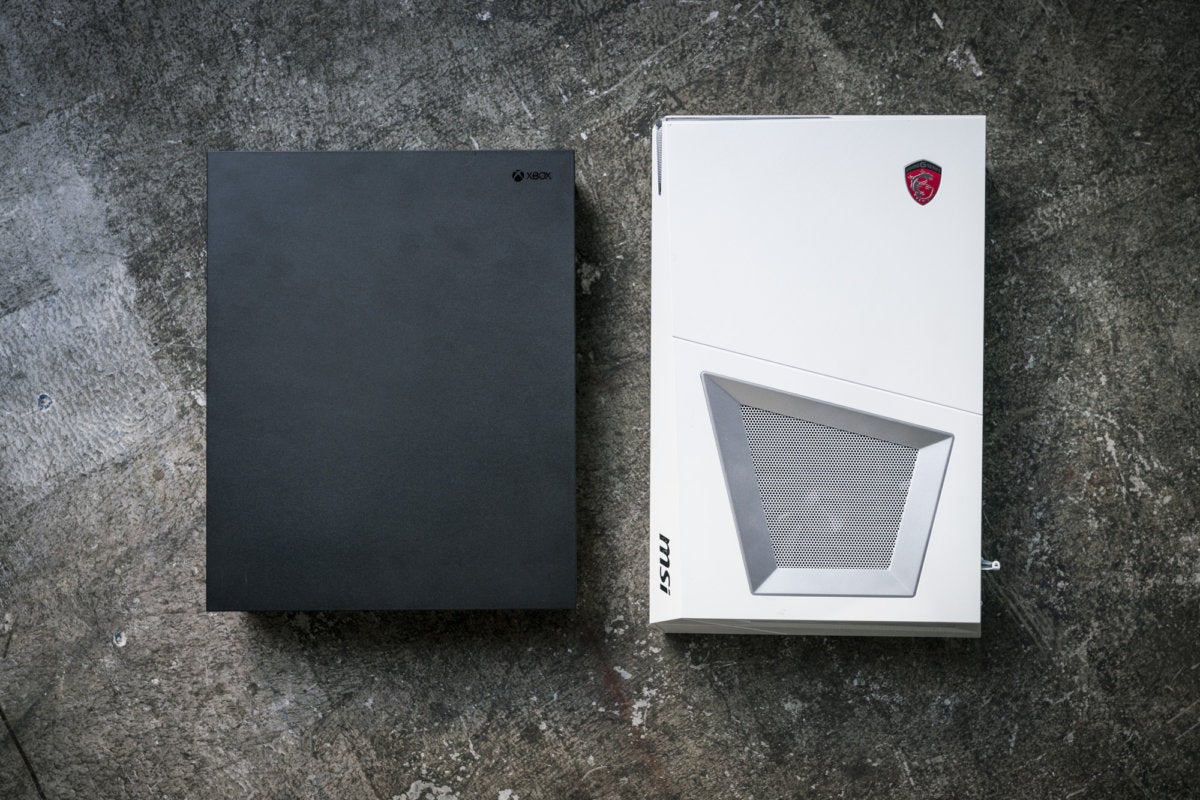
It really is tiny. Musical scale can be tough to guess in photographs, but at 13.6 aside 9.2 by 2.8 inches, the Trident is and so small it's heavily to believe there's a full-size PC inside. It's smaller than my establish-version Xbox Combined for instance, and quite near smaller than the new Xbox Cardinal X. (It's smaller depth, but the Trident is about an inch longer and maybe one-half an inch taller.) The Trident sits comfortably in "console-sized" territory, besides.
 IDG / Adam Patrick Murray
 The Xbox One X (left wing) and Trident (right), as seen from to a higher place.
And it seems even small than it is. The Xbox One's blunt VCR-like chassis looks every inch its size. The Trident's tilted angles are needlessly garish perhaps, but likewise slimming.
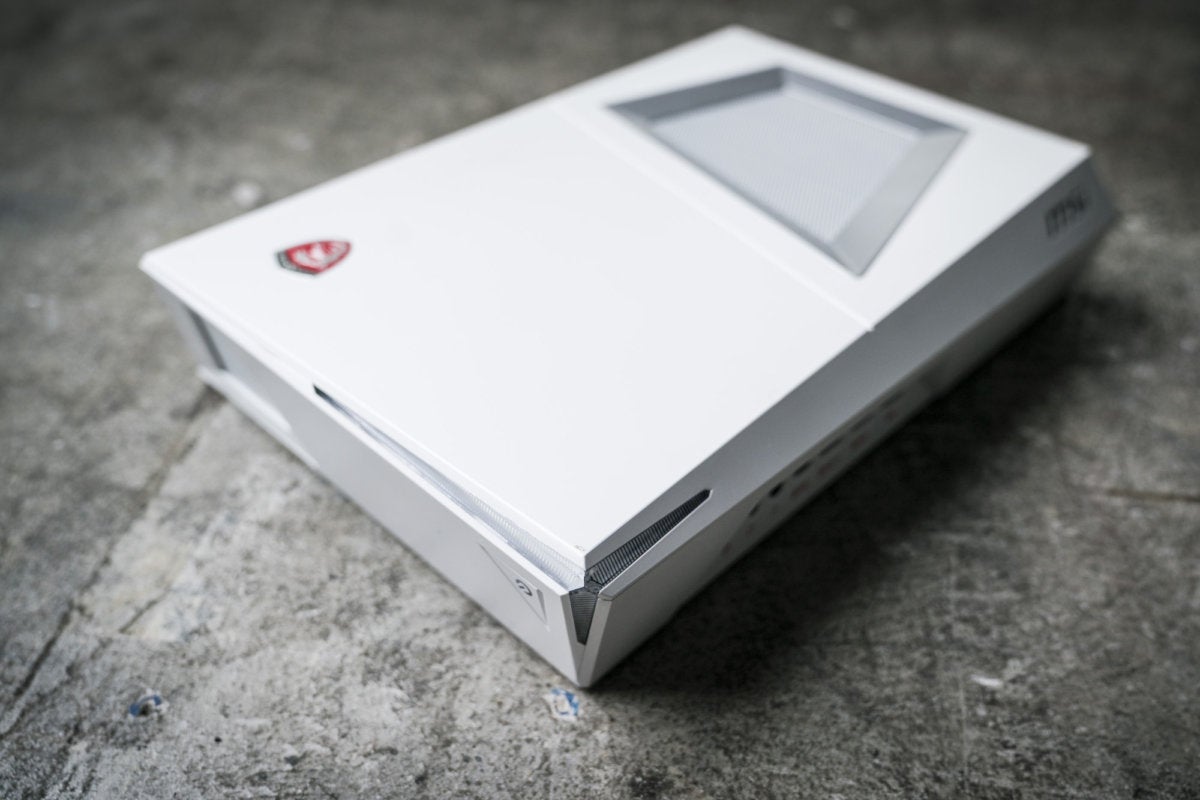
Speaking of garish: I could do without the RGB lighting. That's the one prospect I think detracts from the design, if only when because it's distracting. Given the small size of the Trident I get into most people will put away it happening something, be IT a media center shelf, a desk, whatever. Having an RGB-lit "Y" shape on the front impanel ensures the Trident won't simply blend into the background, as an alternative blink-blink-blinking away at you all night long.
It won't irritate everyone, and it's also customizable—you seat hop into MSI's settings panel and turn the lighting off, "solving" the problem. There's just not a great deal point thereto organism in that respect at all on a machine seemingly so suited for living board use, though.
 IDG / Adam Patrick Sir James Murray
 It's not illuminated here, but that odd "Y" shape on the street corner is the RGB LED zone.
I love the choice of white for the chassis, though. Most of MSI's Trident models issue forth in the company's standard Black-and-red color scheme—as "taxon gaming simple machine" as you can amaze. The model we looked at comes in "Arctic White" though, with a red MSI badge and red labels on the front ports. IT's foxy. I tend to prefer smutty boxes—I feel they support better terminated time—just in that respect's no denying that fresh out of the box the light-skinned Trident is an eye-catcher. Incentive: Fewer noticeable dust.
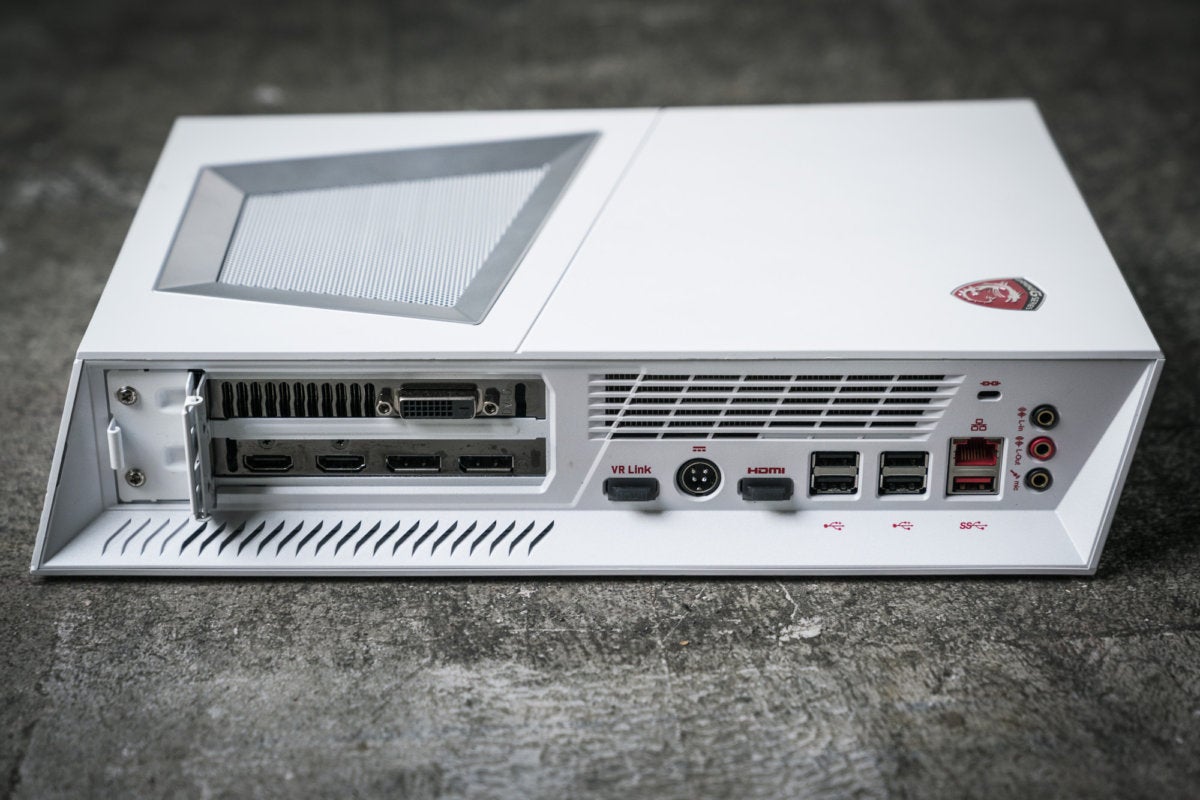
The front panel is laden with ports, which also behooves living-room role. Just about noteworthy is a front-facing HDMI port, which MSI intends for relaxed VR usage. I haven't had much reason to use my HTC Vive with the Trident, but I revalue the gesture. At the moment, plugging in a VR headset means crawling behind my hul Personal computer. Front-facing I/O is sure more convenient.
You'll besides witness 3.5mm headphone and mike ports on the front, plus one USB-C and cardinal USB 3.1 jacks. And despite the motorcar's weeny size, the rear as wel features a surprising number of ports—two more HDMI ports on the motherboard itself, five USB ports, gigabit Ethernet, power, Line-In, Line-Dead/headphones, and microphone. Then there's the graphics card, which features an additive two HDMI ports (for a total of five on the machine), two DisplayPorts, and one DVI.
 IDG / Adam Patrick Murray
 Wrapping up the design, I'll note that the Trident besides comes with a stand, allowing you to run the machine vertically. This is the weakest split up of the package though, with the stand apparently more concerned with esthetics than keeping your PC intact. The stand by neither snaps onto the machine nor screws into it, relying instead on the Trident's weight and four flyspeck rubber pads to keep it upright. If you plan to toss the Trident onto a shelf? It might constitute enough. Simply if you have an unstable desk, pets, children, or are maybe just clumsy? I wouldn't recommend running IT vertical. Even a fairish nudge could send it teetering and (if you're unlucky) toppling all over.
MSI Trident 3 Arctic eyeglasses, Price, and performance
Sanction, so information technology's console-sized. At once how does it stack in the lead? And the answer: Pretty damn good. Actually, the Trident we looked at was ladened, for a machine this small.
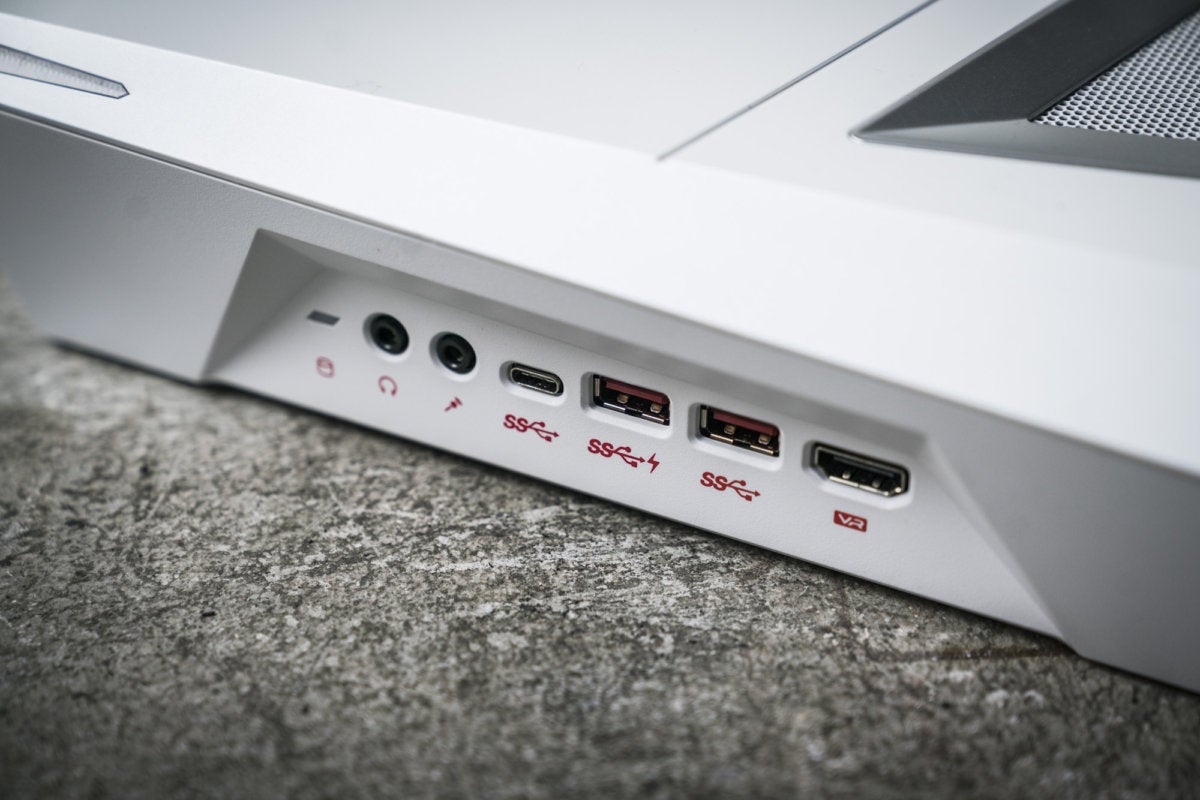
Almost Trident setups unravel with an Nvidia GeForce GTX 1060, which is a perfectly serviceable batting order. (Actually, that puts IT some on par with the Xbox Unitary X.) The $1,450 mold we looked at though takes the next step, somehow packing an 8GB GTX 1070, advantageous an Intel Core i7-7700 clocked at 3.6 GHz, 16GB of DDR4 Pound, and both a 256GB SSD and a 1TB hard drive. Again, that's into a machine smaller than the original Xbox One.
 IDG / Adam Patrick Murray
 IT's incredible. Sure, you're non exit to get the same performance arsenic a full tower with a GTX 1080 Atomic number 2 in spite of appearanc, but in a auto this size of it? Belly laugh. Arsenic I said, even the Xbox One X tops impermissible at GTX 1060 levels of power, which makes the Trident V3 more powerful than even the most ruling console on the market today. We ran the Trident through with our usual battery of benchmarks, with fulgurous results—impressive if just because something this humble put up scores siamese to ladened-wolf-sized towers.
E.g., in Rise of the Tomb Raider at 1080p with settings connected Very High, the Trident 3 averaged 107.9 frames per second. That's right in line with unusual 1070-well-found machines like a 1070-accoutered GB PC that we've looked at, which averaged 107.8 frames per second. The same goes for Shadow of Mordor with the 4K texture pack installed—130.2 frames per second for the Trident V3, 129.2 for the Gigabyte machine.
The Trident 3 even holds its own in lengthier benchmarks. That's eye-popping. In-game benchmarks are usually only a few minutes long at best, thus you don't very see outpouring throttling because the ironware doesn't heat up enough for it to matter. Simply in one of 3DMark's lengthier tests or our CPU-central Handbrake encode you sometimes see heat dispersion problems you might've otherwise overlooked.
Not here. In 3DMark's FireStrike Extreme exam the Trident put prepared a score of 7828, which compares favorably to the GB machine's 8313. And in our Handbrake test, where we transcode a 30GB MKV single file thrown to the Android Tablet planned, the Trident 3 did it in about 38 transactions and 46 seconds—only 16 seconds longer than the Gigabyte. All evidence points to there being no significant thermal issues. The machine gets hot for certain, but equally far as I can recite it's non significantly affecting functioning.
"Okay, so then noise is an issue right-minded? If it's moving that much heating system, obviously the fans must be distracting." Nope! Surprisingly it's both comparatively cool and reposeful. Not whisper-implicit, to be sure, but at even moderate volumes my sound system drowned come out of the closet the Trident's fans—and that was with it on my desk. If you placed it across the board, you'd in all likelihood ne'er hear it. It's certainly quieter than 2013's Xbox One model, and about on equivalence with the new Xbox One X.
MSI Trident 3 upgradeability
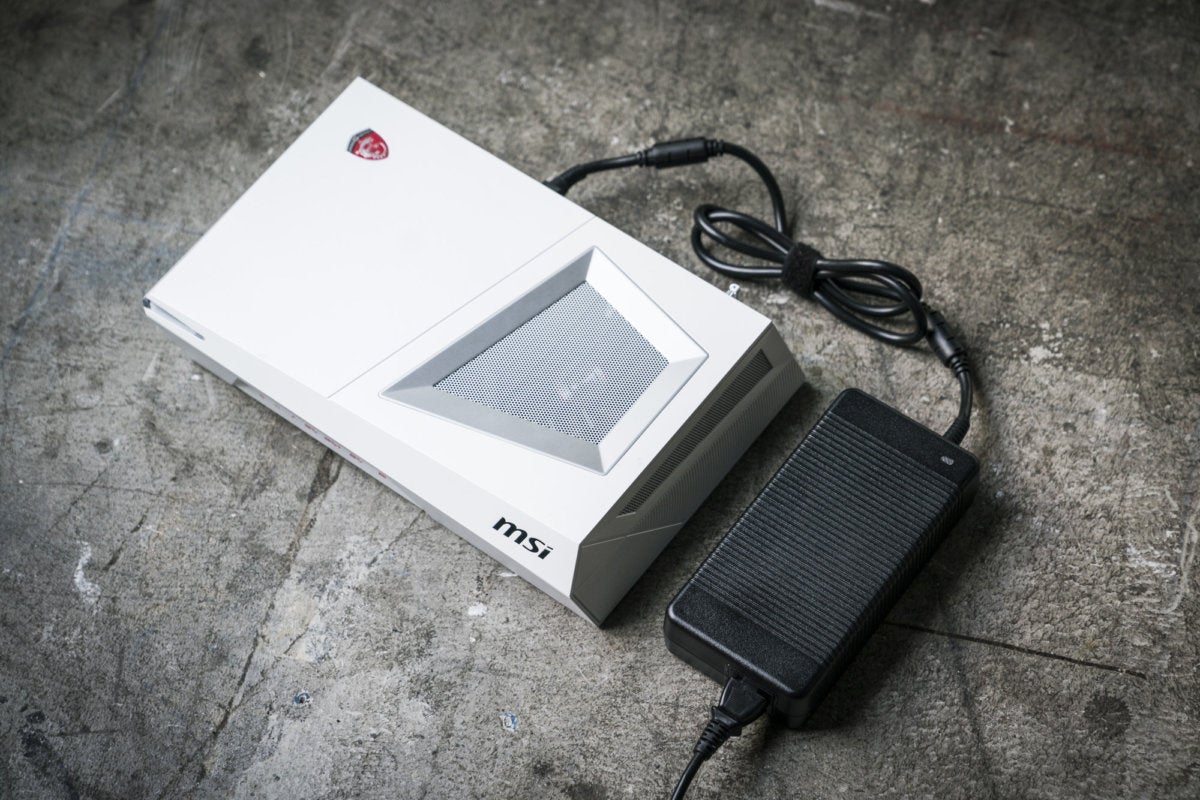
But the most important scene of the Trident 3: It's non only small, only upgradeable. Properly upgradeable, more often than not thanks to the aforementioned GTX 1070. See, most Trident models ship with a GTX 1060—a low-power bill. As such, they get away with run on a 230 W power brick.
That's fine, as long as you only ever plan to replace the 1060 with an equivalent card, but even upgrading to a 1070 would likely cause problems under warhead with that small a power supply.
 IDG / Adam Saint Patrick Murray
 Since our model ships with a 1070 though, it also packs a 330 watt provide. That's not much more than the baseline Trident, and IT all the same comes in ugly power brick form so you'll have to find some duplicate room to stash it, but you might have a bit of headroom for overclocking if you're careful. The GPU is likewise easily accessed, and can be swapped tabu for whatsoever different lilliputian form-factor menu as long A you hold the power restrictions in psyche. Ternion or quaternary years down the line you should make up able to flump in a GTX 1470 or whatever and be soundly to go.
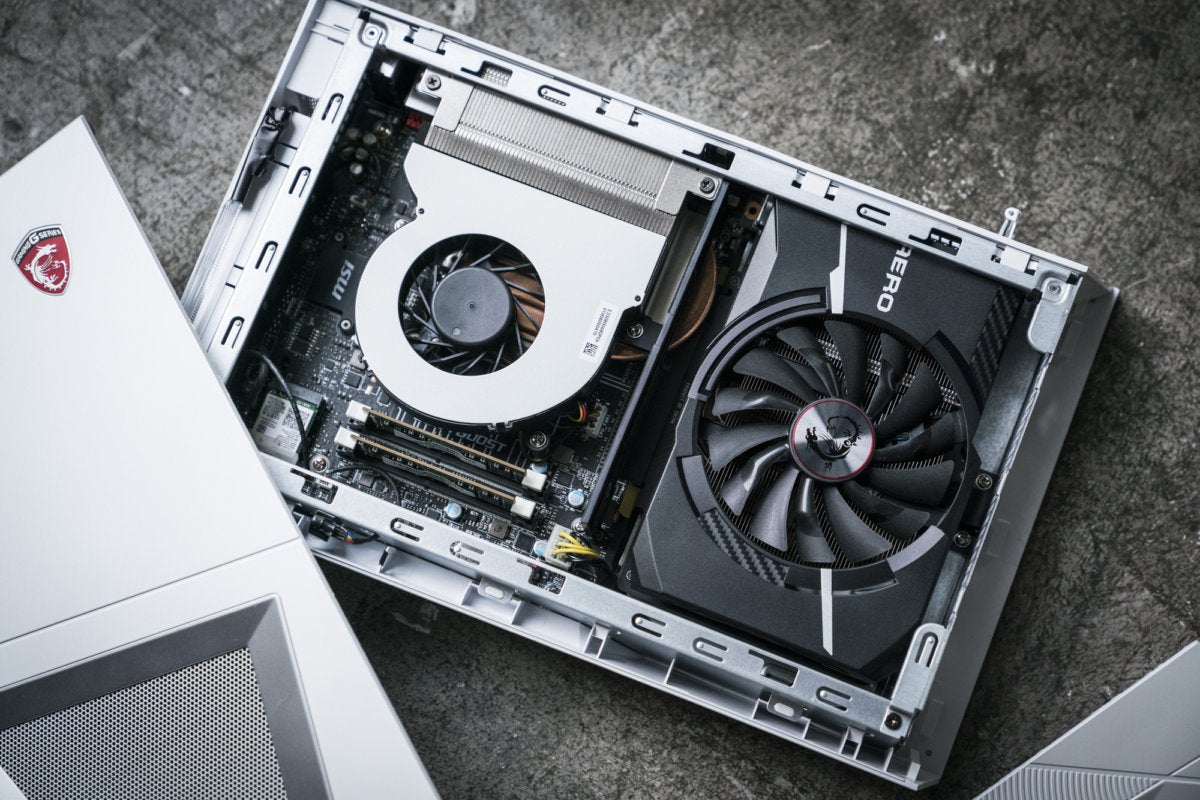
The GPU isn't the only part that's upgradeable though. Two screws gets you into the case, which is enough to supervene upon the RAM immediately. The Central processor would accept more doing, but you can disassemble the cooling and swap information technology out if desired. That would only constitute in the outcome of complete failure though—the motherboard is proprietary, and inclined Intel's fondness for switching CPU sockets lately you're belik not going to be able to drop in a new-generation processor later.
 IDG / Adam Patrick Murray
 Chock up and CPU on the left, GPU on the in good order.
I only have a dyad complaints. Accessing the hard drives is a royal pain, requiring you to flip the simple machine over and remove the intact can panel. IT'd be easier to just use an external drive I guess, only it's annoying given the Trident's 1TB drive. First thing I'd want to do is upgrade that, and it's harder than it needs to comprise. More annoyingly, you void your warranty past tinkering. That's not excessively uncommon with prebuilts, but there is indeed a paster over one of the screws every bit you head privileged.
If you want to really tinker? Positive, get a afloat tower or human body your own. Hush up, if you want a small machine that remains a decent investment three or four years down the line? The Trident 3 gives you enough runway to promote the most important components a few times, and replace the nearly likely points of failure to a fault. That's better than a great deal of machines its size (not to mention gaming consoles).
Fanny line
The MSI Trident 3 Arctic offers the power of an upper-middle tier PC in a figure the size of the new Xbox One X—and with the ability to upgrade it true further in a few years with a hypothetical GTX 1470 or whatever. It's inviting, it's small, it's (mostly) discreet, and it's also surprisingly inexpensive. The 1070-well-found model we looked at retails for a mere $1,450 on Amazon. Doing some lepidote back-of-napkin math, I estimate you'd only save maybe $200 or $300 on a marginal bones Miniskirt-ITX build up of your own, and piece you'd gain some additional board for upgrades later it definitely wouldn't turn down this streamlined, nor pull off fire u this efficiently.
Whether you'rhenium looking at for a extant way machine, a dorm-room Microcomputer, operating theatre something convenient to take to those LAN parties you and your friends are still (in 2017!) having, the Trident 3 is emphatically worth a see—specifically this GTX 1070 poser. The 1060 units? Eh, I'd probably give those a pass. But this is one hell of a whole lot.

Source: https://www.pcworld.com/article/407590/msi-trident-v3-arctic-review.html
Posted by: beasleyjustoll.blogspot.com
0 Response to "MSI Trident 3 Arctic review - beasleyjustoll"
Post a Comment