

Nvidia GeForce RTX 2080 and RTX 2080 Ti review: Changing the game - beasleyjustoll

At a Glance
Skillful's Rating
Pros
- The first graphics visiting card for 4K, 144Hz monitors
- Gorgeous, immensely built Founders Edition designed
- Supports ray tracing, DLSS, and VirtualLink
Cons
- Individual hundred dollars Thomas More overpriced than predecessors
- Ray tracing and DLSS non available in games yet
Our Verdict
Nvidia's GeForce RTX 2080 Titanium costs significantly to a higher degree its predecessor, but information technology's also the first-class honours degree graphics card equal to of gaming well late the 4K/60 barrier. If you lav give information technology, this art card can feed a 4K, 144Hz monitor like nary other, and it's built for the future with dedicated ray trace hardware.
Best Prices Today

$1199.99
The GeForce RTX 2080 and RTX 2080 Atomic number 2 aren't like any other consumer graphics cards. Nvidia improved these card game for the future. So much so, in fact, that we'rhenium departure to take the unusual step of not interpretation a last, rated verdict today.
Unequal active graphics card game, these let in dedicated RT cores to vastly improve real-time ray tracing performance, putting the Grail of gaming graphics within get hold of. As wel different existent graphics cards, the GeForce RTX 2080 and 2080 Ti let in dedicated tensor cores to purchase the awesome power of machine learning and a Saturn V supercomputer in the games you play. Nvidia's new hardware is the first designed specifically for the 4K, 144Hz HDR geological era, with a revamped architecture that increases carrying out in traditional games, and they're the first graphics cards equipped with GDDR6 remembering OR a VirtualLink connector. Our Nvidia Turing GPU deep-dive explains all.
Only dynamic the brave doesn't come cheap. These graphics cards price much, much more than their predecessors, and buying into Nvidia's futuristic sight requires a big leap of faith—ray traced games South Korean won't fifty-fifty follow ready when they launch. Are the GeForce RTX 2080 Founders Edition ($799 at the best BuyRemove non-product link or GeForce.com) and RTX 2080 Ti Founders Edition ($1,199 at Best BuyRemove non-merchandise link and GeForce.com) worth your money today? Let's entrench.
GeForce RTX 2080 and 2080 Ti: Eyeglasses and features
Here are the high-level eyeglasses for the GeForce RTX 2080 and GeForce RTX 2080 Ti, before we delve into both of the more interesting bits:
GeForce RTX 2080 Cordyline terminalis:
- CUDA cores:4,352
- Clock speed: 1,350MHz base, 1,545MHz boost (OC Founders Edition 1,635MHz further)
- RT cores: 72
- Tensor cores: 576
- Texture units: 288
- ROP units: 96
- Retentivity capacity:11GB GDDR6
- Computer storage path:352 bits
- Memory bandwidth:616GBps
- Ports:VirtualLink/USB-C, DisplayPort 1.4, HDMI 2.0b
- Power: 2 x 8-immobilise, 250W TDP livestock, 265W TDP OC Founders Edition
- Release date:September 27, 2018
- Price: $999 stock, $1,199 Founders Edition
GeForce RTX 2080:
- CUDA cores:2,944
- Time speed: 1515MHz base, 1710MHz boost (OC Founders Variation 1800MHz hike up)
- RT cores: 46
- Tensor cores: 368
- Texture units: 184
- ROP units: 64
- Computer storage capacitance:8GB GDDR6
- Memory path:256 bits
- Memory bandwidth:448GBps
- Ports:VirtualLink/USB-C, DisplayPort 1.4, HDMI 2.0b
- Force:One 6-pin, one 8-pin, 215W TDP stock, 225W TDP OC Founders Edition
- Release date:September 20, 2018
- Price: $699 stock, $799 OC Founders Variation
The GeForce RTX 2080 and 2080 Ti Founders Edition card game come overclocked out of the box. That's a first-year for Nvidia's reference card game, and a nice perk up for the people who plonk down extra cash for a Founders Variant model, but it makes establishing a operation baseline difficult. Nvidia GPUs scale of measurement clock speeds depending on fountain and power constraints. You can't just use an overclocking puppet to bring the RTX cards down to stock boost time speeds and count that As gospel. So the benchmark results you'll catch in that review are higher than you'd puzzle out with an RTX 2080 or 2080 Ti that truly sticks to reference speeds.
Reference speeds for some card game are slower out-of-the-box than those of their predecessors, however. On the flip side of meat of the coin, Nvidia says it expects the RTX 20-series to overclock improve than the GTX 10-series, and it's shipping a new Nvidia Scanner API that lets you auto-overclock your graphics lineup with a single push of a push. Our know with an early version of the tool wasn't quite so seamless, but we'll be testing release versions of Electronic scanner ASAP. Search it in updated versions of popular overclocking software, such as EVGA's Precision.
 Brad Chacos/IDG
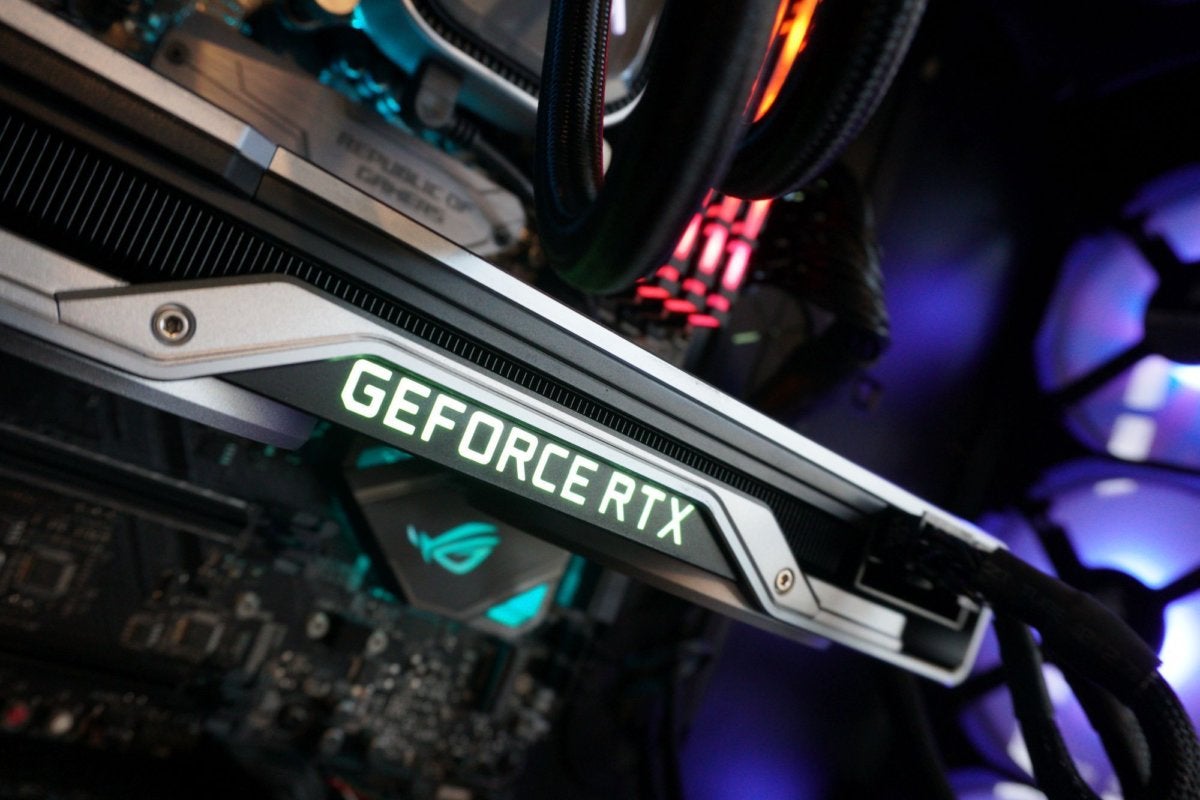
 The upgrade to GDDR6 pays dividends on the memory side. The GeForce RTX 2080 Te and GeForce GTX 1080 Ti boast identical memory capacity and jalopy widths, but the new card hits a blazing 616GBps, versus the GTX 1080 Ti's 484GBps. That also surpasses the ultra HBM2 memory in AMD's Vega nontextual matter cards, which bump off 484GBps like the GTX 1080 Ti. WHO says traditional VRAM is departed?
Finally, the TU102 GPU inside the RTX 2080 Cordyline terminalis is a bigger, to a greater extent high-risk-ass version of the RTX 2080's TU104 GPU in every aspect, including those swanky new RT and tensor cores. The GeForce RTX 2080 Ti has 56.5 percent more of all, which could reach a big difference of opinion when the starting time games with ray tracing and Nvidia's Deep Learning Super Sample distribution get. They aren't here however so we arse't bench mark them, but it's something to atomic number 4 aware of if you're totally-in on the idea of ray tracing.
That's all most people call for to get laid about the GeForce RTX 2080 and 2080 Ti. For much Sir Thomas More information in very much greater technical detail, confirmation out our massive Turing GPU heavy-dive.
Nvidia GeForce RTX Founders Edition design
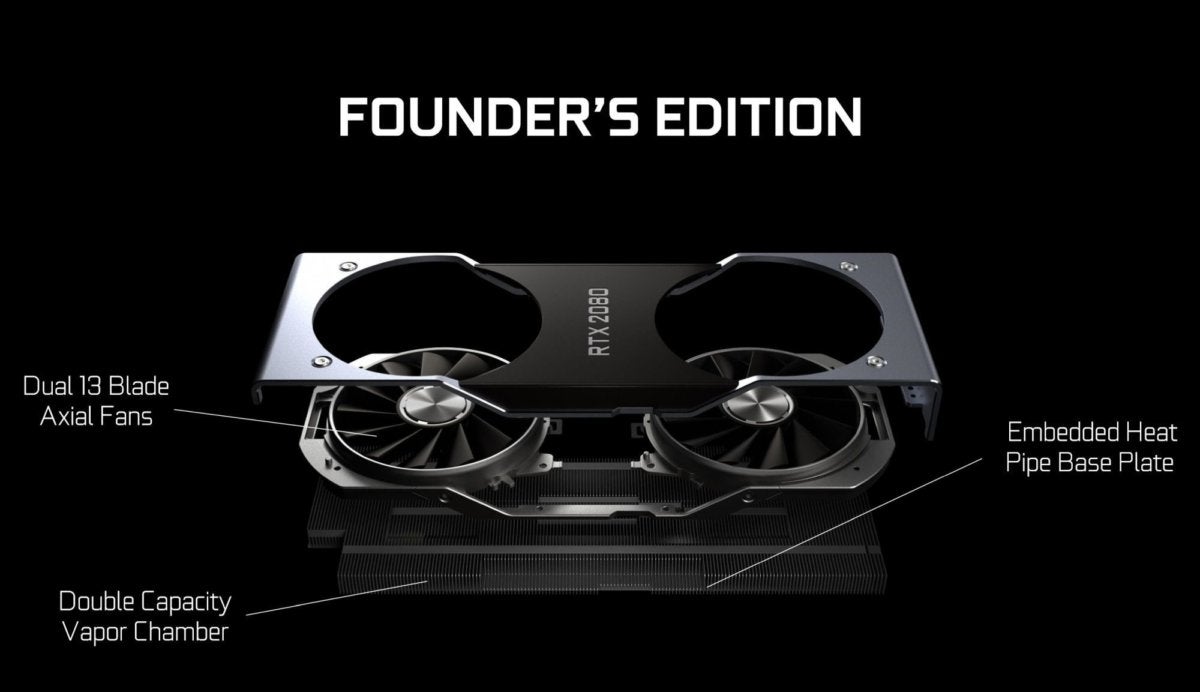
Nvidia shook up the exterior of its GeForce RTX Founders Edition right as very much like the interior. Say adios to the single-fan, blower-style design established long since for reference designs from both AMD and Nvidia. Now, Nvidia's competitory with its hardware partners in tank design, too.
 Nvidia
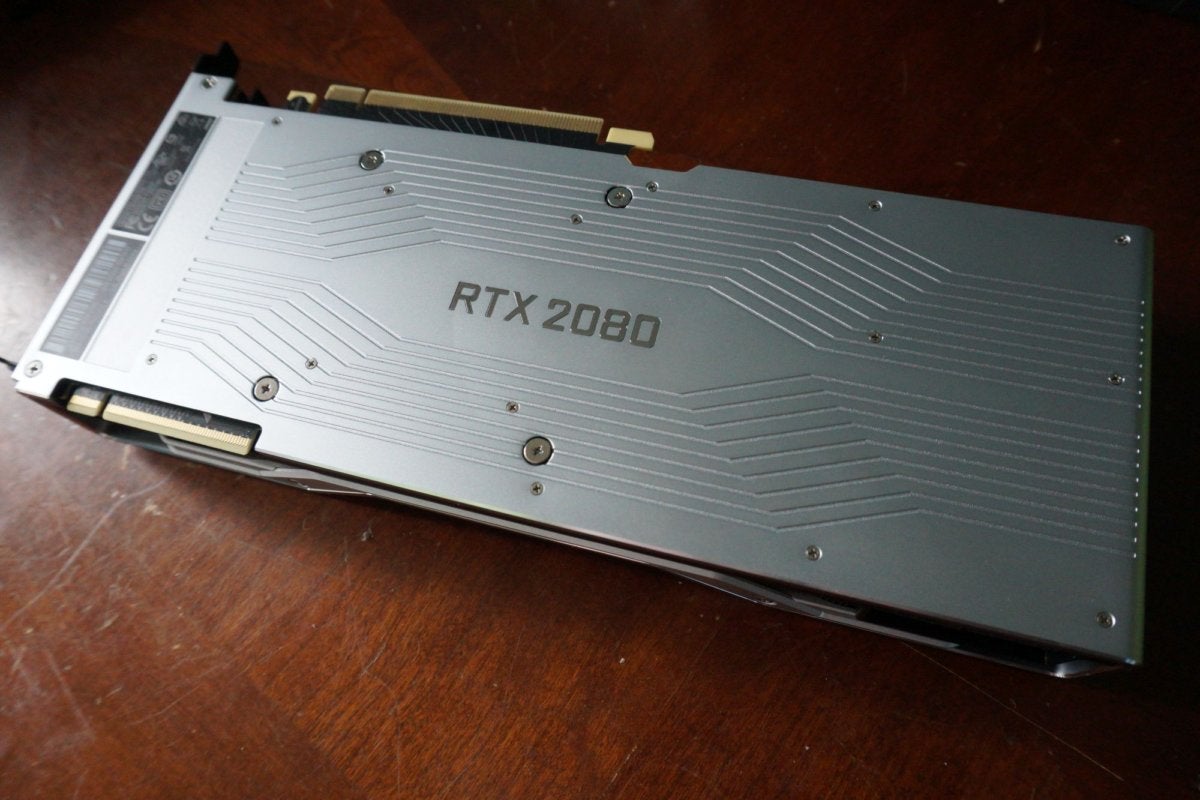
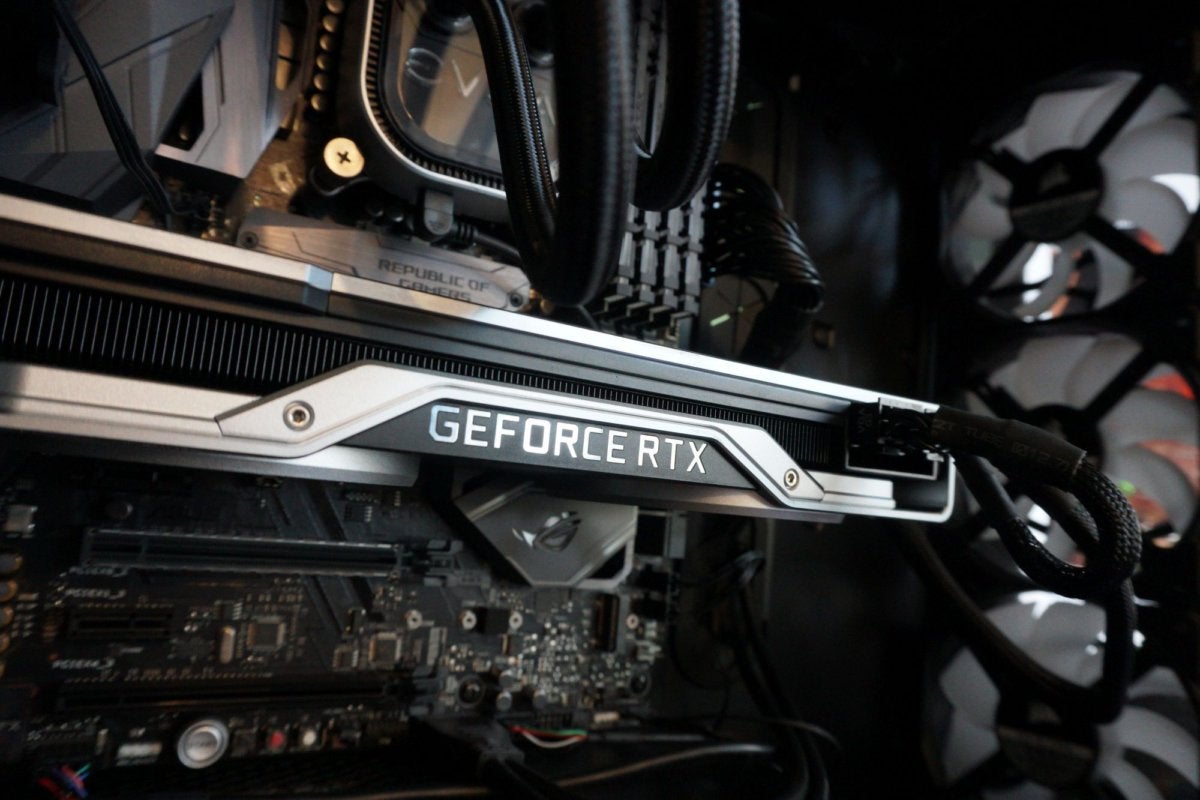
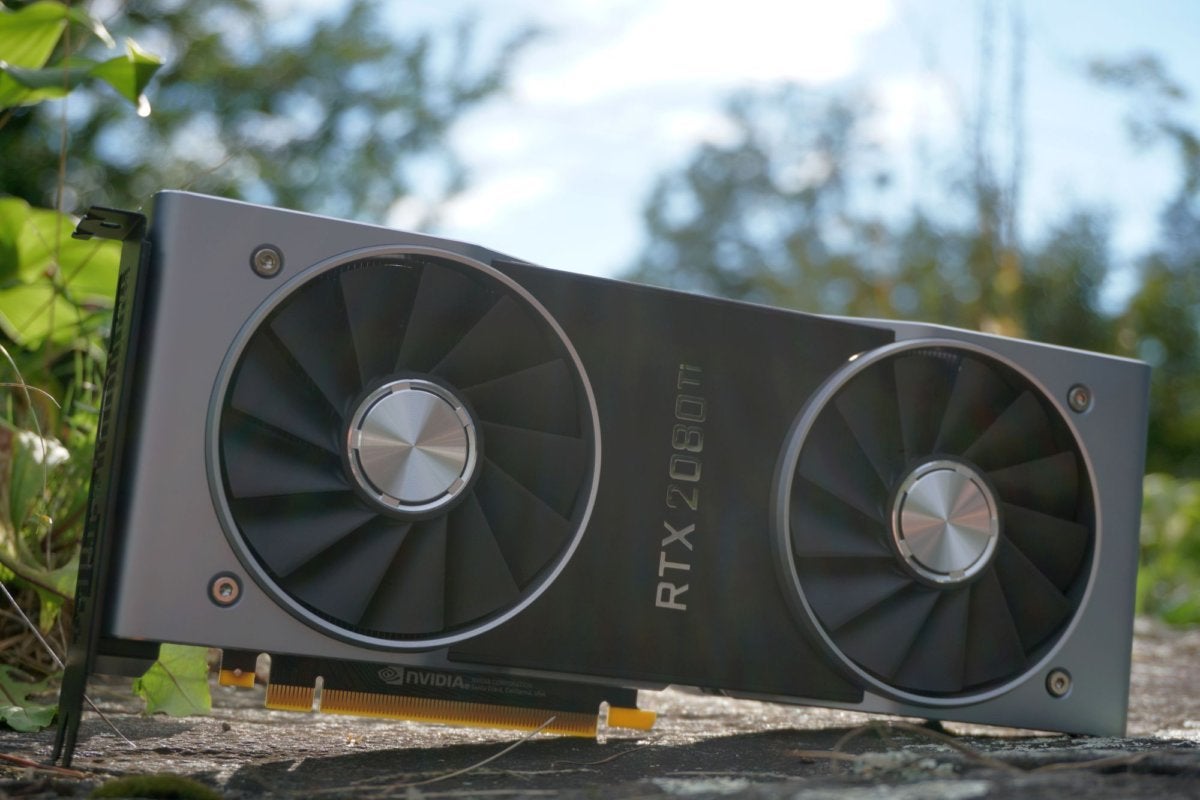
 The GeForce RTX 20-series Founders Variation cards upgrade to dual axial fan design, and those fans—spread farther apart than you see in most graphics cards—come equipped with 13 blades all. They'ray sitting atop a card-length heat sink with a heat pipe enclosed in the base plate, and a full-length vapor chamber to dissipate heating system from the GPU and other components. A forged aluminum cover covers those cooling components, curving around the end of the card to transform into a sleek backplate with the graphics carte du jour's name emblazoned crossways it. It's an utterly beautiful enclosed blueprint, and past my touch after an intense benchmarking discoidal, that backplate helps dissipate hotness As well.
 Brad Chacos/IDG
 These Founders Edition models feel impressively substantial in your hand. Nvidia claims the new design is five times quieter than the previous nonpareil, and up to around 20 degrees cooler depending on the scenario. We didn't find it quite that potent, as you'll see in our performance benchmarks, but it's indeed a significant improvement over the older blower-style design. An light green "GeForce RTX" logo classes finished the side bound of the plug-in.
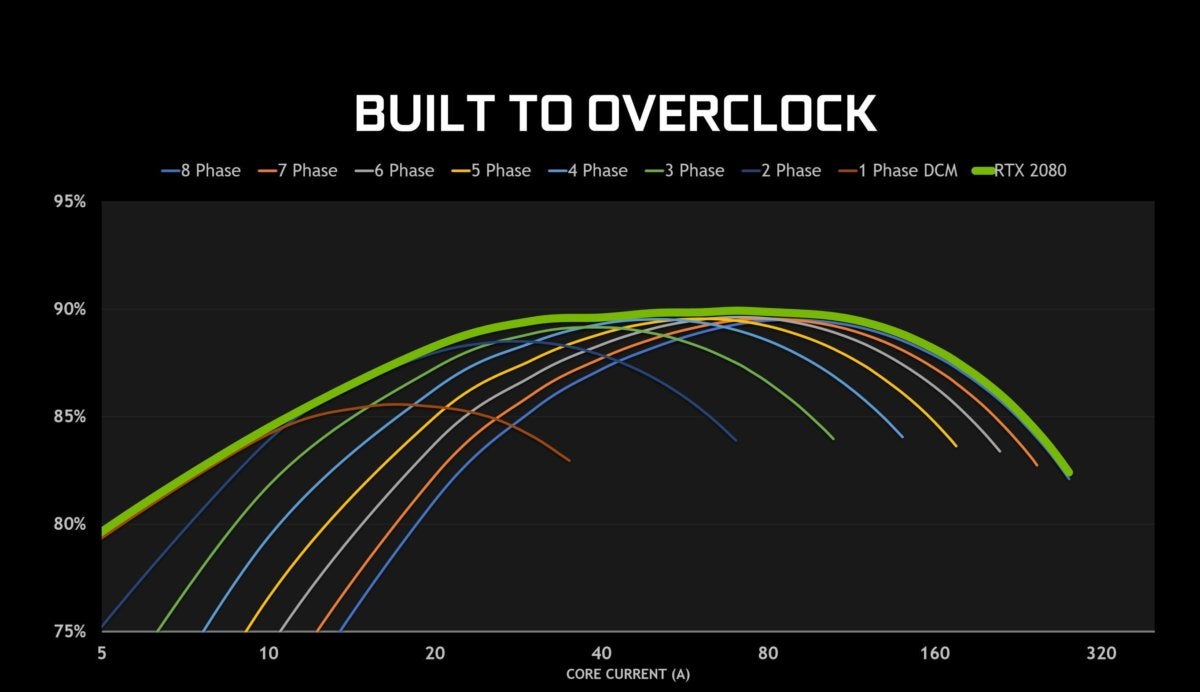
Nvidia bulked up the Founders Variant PCB, too. It includes more overclocking headroom than the previous plan did, bounteous you 55 watts to play with rather than 38, and cleaner boilers suit index delivery, per product manager Justin Pedestrian. It also includes an 8-phase design that can dynamically substitution hit those phases if you aren't pushful the card hard, to improve efficiency.
 Nvidia
 Both Founders Edition card game touchstone 10.5 x 4.55 inches, in a orthodox two-slot design. The GeForce RTX 2080 FE pulls 225W over a 6-oarlock and an 8-peg power connector, piece the RTX 2080 Ti Atomic number 26 pulls 260W via dual 8-pin connections. Nvidia recommends a 650W power supply for each.
Finally, at that place's been a wag-upfield in display connections, too. A VirtualLink USB-C connector now adorns the Founders Edition cards, capable of supplying all the video, audio frequency, and data pipelines necessary to power a virtual reality headset…whenever VirtualLink starts appearing in VR headsets, that is. It's joined by a uniform HDMI 2.0b port, and dual DisplayPort 1.4 connections that are ready for DisplayPort 1.4a in the future.
Got it? Good. On to the benchmarks!
Next pageboy: Test system overview, gaming benchmarks begin
Our test system
We've completely revamped our graphics card exam system for this new generation of graphics card game, as the Core i7-5960X-based tackle we dedicated to GPU benchmarking was starting to show its age. We've loaded our New organization with some of the fastest complementary computer hardware about, in hopes it'll comprise our bedrock for few years, like our last one. Fingers crossed. The components we selected are known for being beastly overclockers, in casing we need more oomph in the future.
Present's what's inside. Just about of the ironware was provided by the manufacturers, but we purchased the cooler and store ourselves.
- Intel Core i7-8700K processor ($360 on Virago)
- EVGA CLC 240 closed-loop liquid cooler ($120 on Amazon)
- Asus Maximus X Torpedo motherboard ($260 on Amazon)
- 64GB HyperX Marauder RGB DDR4/2933 ($416 for 32GB on Amazon)
- EVGA 1200W SuperNova P2 power append ($180 on Amazon)
- Corsair Crystal 570X RGB case, with front and crown panels remote and an duplicate rear fan installed for improved airflow ($170 on Amazon)
- 2x 500GB Samsung 860 EVO SSDs ($100 on Amazon)
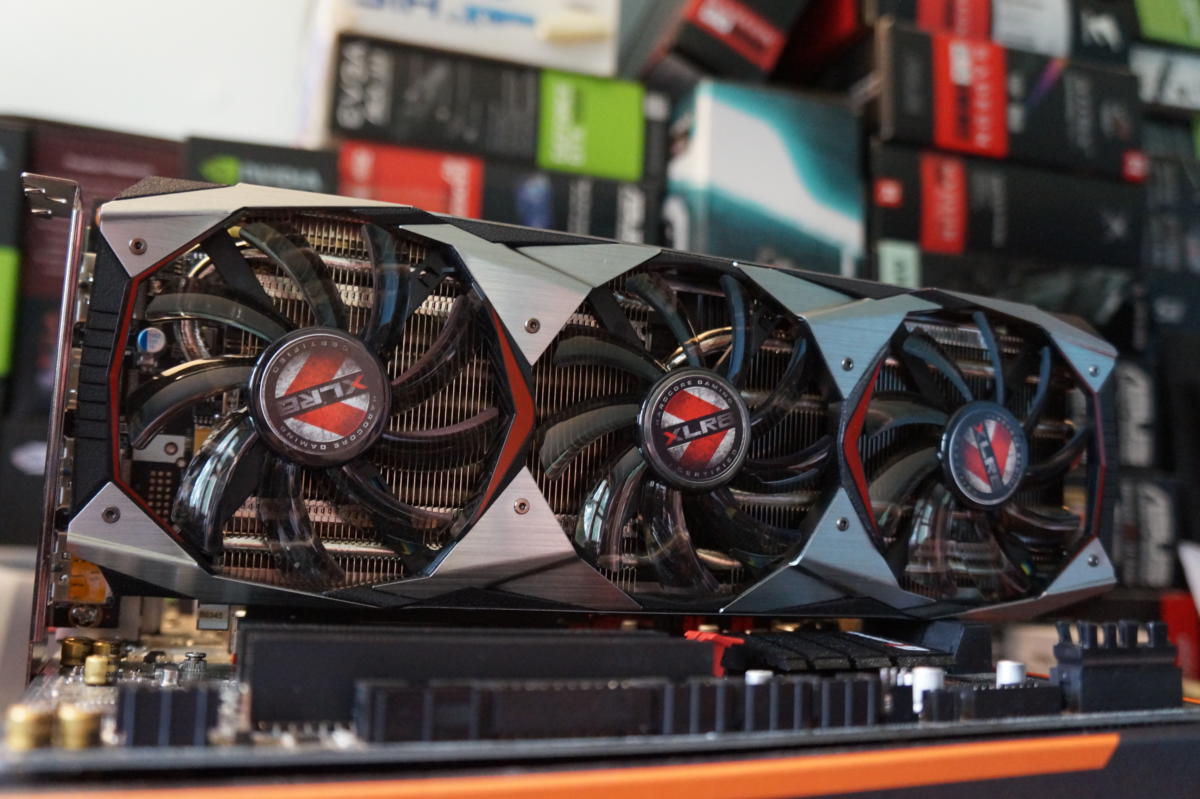
We'ray comparing the GeForce RTX 2080 Founders Edition ($800 on GeForce.com) and RTX 2080 Ti Founders Edition ($1,200 on GeForce.com) against the GeForce GTX 1080 Founders Variation and PNY GeForce GTX 1080 Ti. Neither of those are on sales agreement whatever longer, just you can find other customized GTX 1080s protrusive approximately $470 on Newegg, and custom GTX 1080 Tis starting more or less $700 on Newegg, though we've seen both connected sale for significantly cheaper prices in late weeks. We prefer to compare credit cards to character reference card game for these initial reviews, but unfortunately our GTX 1080 Ti Founders Edition gave up the ghostwrite, so PNY it is. With Nvidia applying an unstylish-of-the-box overclock to the RTX Founders Edition models, comparing them against an overclocked GTX 1080 Titanium doesn't flavour horrible—though note that the PNY model is about 6 percent quicker than a GTX 1080 Ti Founders Edition.
 Brad Chacos/IDG
 The PNY GTX 1080 Ti XLR8.
We're too tossing AMD's most potent GPU, the Radeon Vega 64, into the mix to see where information technology stands. Note that this is the cool source variation, not the liquid-cooled framework. We have a limpid-cooled version, merely IT's no more for sale and was only available in limited quantities. Custom Vega 64 models start around $500 on Newegg, though most sell for $550 or more.
Each game is tried and true using its in-game benchmark at the highest possible graphics presets, with VSync, soma grade caps, and all GPU vendor-particular technologies—like AMD TressFX, Nvidia GameWorks options, and FreeSync/G-Sync—disabled, and temporal opposed-aliasing (TAA) enabled to force these high-end card game to their limits. If anything differs from that, we'll refer IT. Let's go!
GeForce RTX 2080 and 2080 Ti gaming operation
Strange Brigade
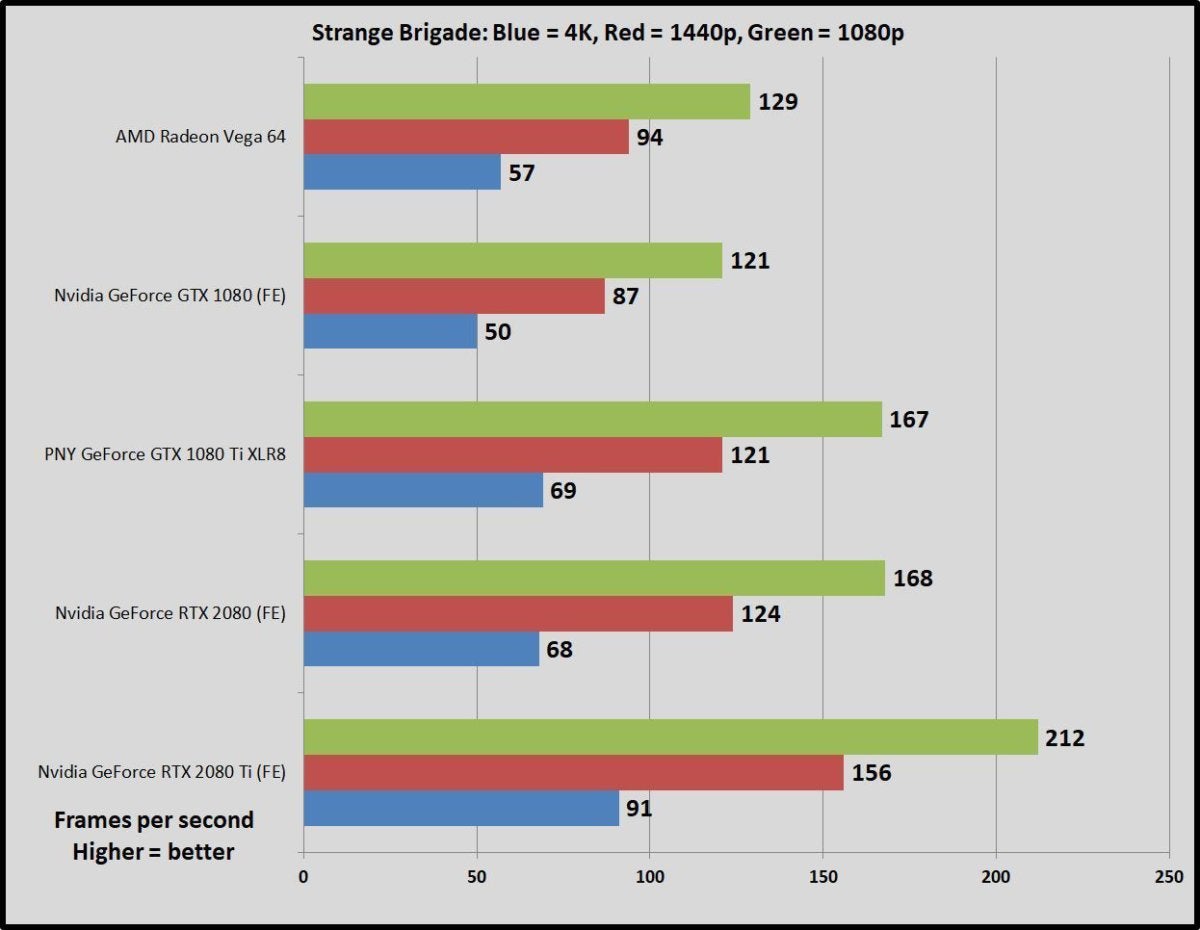
Countenance's kick things forth with Strange Brigade ($50 on Humble), a cooperative third-person shooter where a team of adventurers blasts through hordes of mythological enemies. It showcases the next-gen Vulkan and DirectX 12 technologies and is infused with features look-alike HDR support and the ability to toggle asynchronous compute happening and slay. We tested DirectX 12 with async compute off, as it traditionally only boosted Radeon GPUs.
 Brad Chacos/IDG
 Ordinal thought: Man, the GeForce RTX 2080 and GTX 1080 Ti are nearly identical in performance. That's a theme we'll continue to see end-to-end these benchmarks. The RTX 2080 Te leapfrogs its predecessor by almost 32 percent at 4K, though the overclocked nature of some cards makes the comparison a smallish murky. The RTX 2080 Ti's confidential information shrinks the lower you enter upon resolution, though it systematically corpse the quickest nontextual matter circuit card by a considerable security deposit. Also worth noting: AMD's Lope de Vega 64 trumps the GTX 1080 even with async compute turned off.
 Brad Chacos/IDG
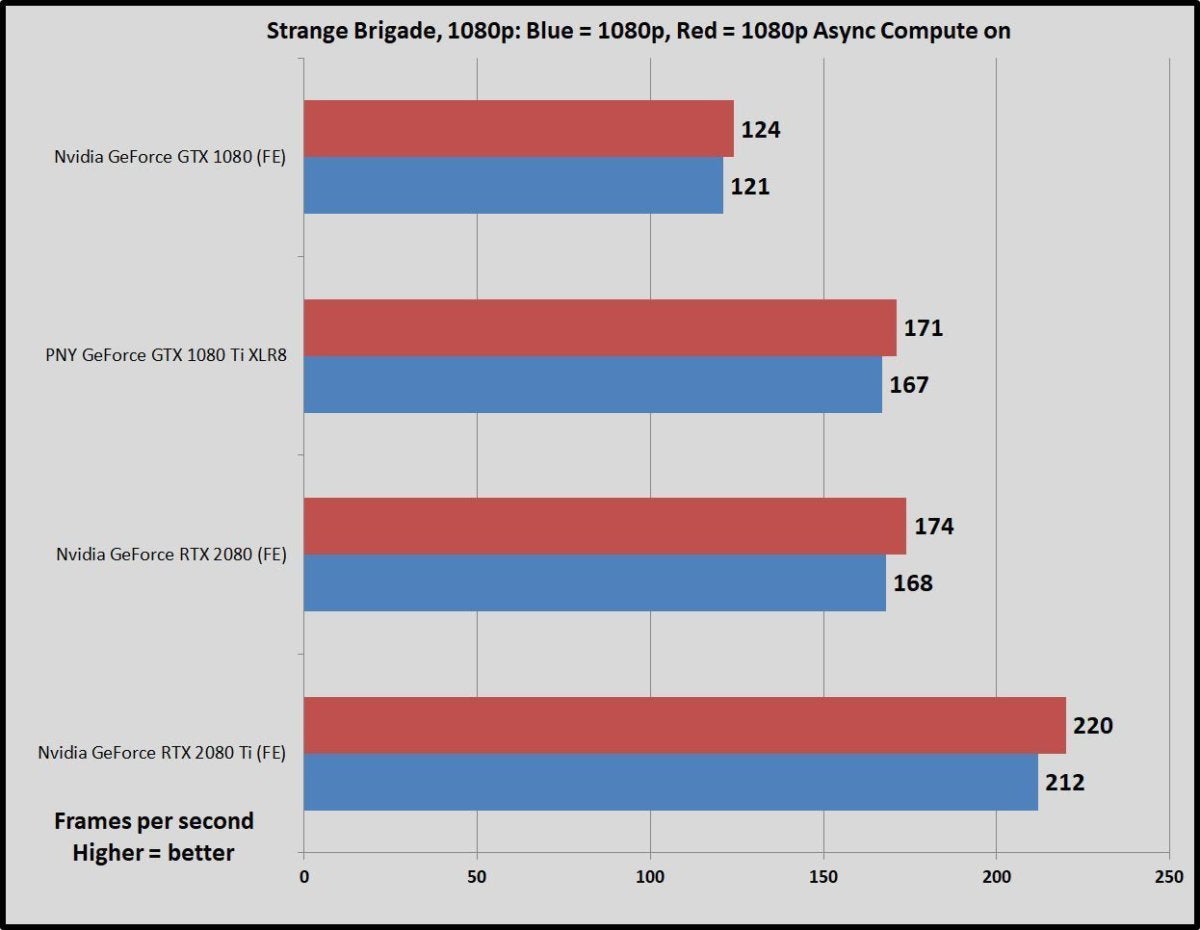
 We also tested Tramontane Brigade with async compute enabled for the GeForce cards at 1080p resolution, to see if the freshly INT32 pipeline exclusive the RTX 2080's Turing GPU architecture improved performance at that place. It does, just only by about 3.6 per centum in this particular scenario.
Next page: More benchmark results
Shadow of the Tomb Raider
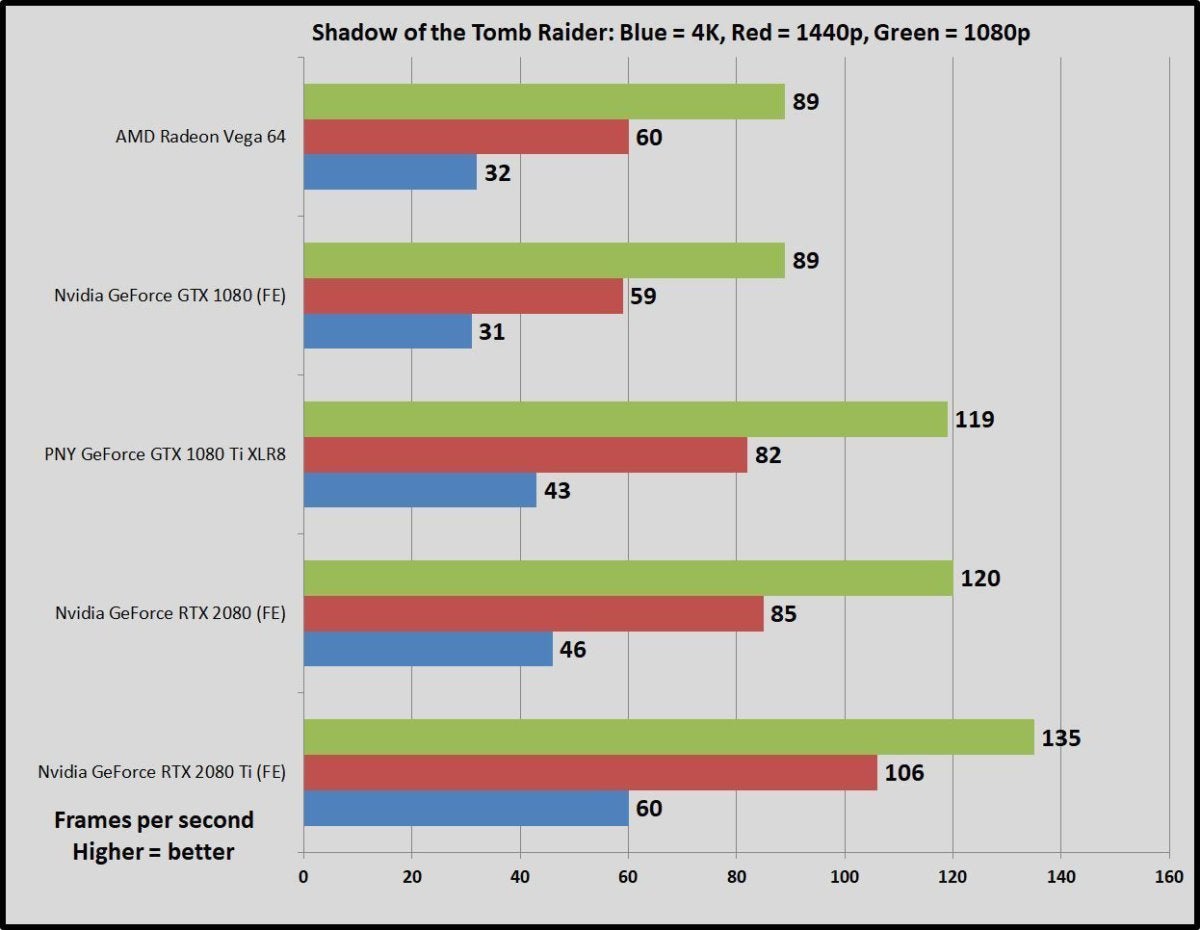
Shadow of the Tomb Raider ($60 connected Humiliate) concludes the reboot trilogy, and it's perfectly beautiful—much then that even the state-of-the-nontextual matter GeForce RTX 2080 Atomic number 2 barely manages to normal 60 fps with wholly the bells and whistles turned on at 4K resolution. Lame Enix actually optimized this game for DX12, and recommends DX11 only if you're victimisation older hardware Beaver State Windows 7, thusly we test with that.
 Brad Chacos/IDG
 Again, the RTX 2080 and GTX 1080 Ti are neck-and-neck, while the GeForce RTX 2080 Ti Founders Edition stays call at front away nearly 30 percent at 4K. Three distinct tiers of GPUs are starting to emerge: The GTX 1080 and Vega 64 trade blows around $500, the RTX 2080 and GTX 1080 Ti duke information technology call at the $700-to-$900 tier, and the GeForce RTX 2080 Atomic number 2 stands all on its have at $1,200-plus.
Far Cry 5
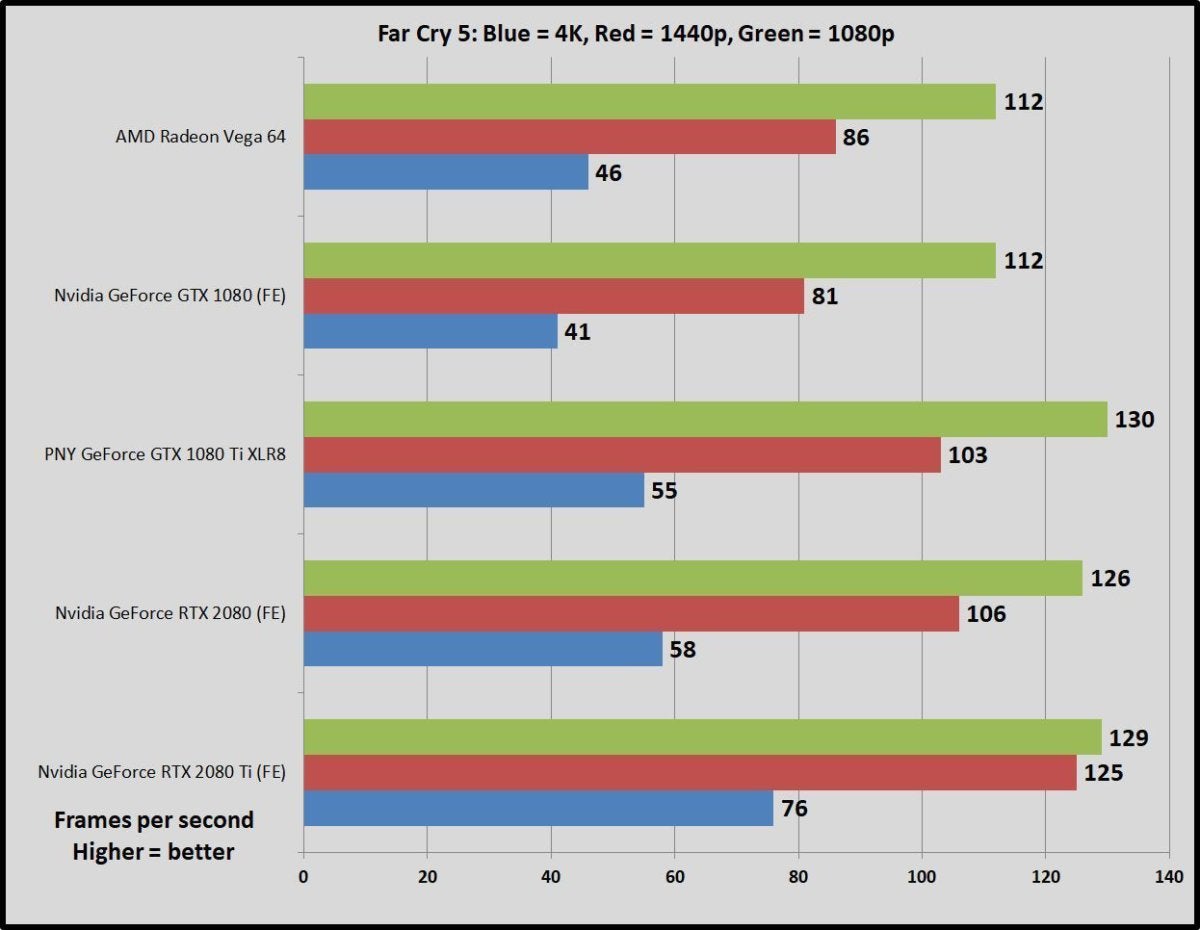
Finally, a DirectX 11 game! Far Cry 5 ($60 on Unskilled) is powered by Ubisoft's long-ingrained Dunia locomotive engine. It's even as gorgeous every bit its predecessors—and even much fun. The game also supports HDR. More on that later.
 Brad Chacos/IDG
 The same performance trends we've seen earlier continue Hera. Federal Reserve note that if you'ray exploitation a 1080p, 144Hz proctor, the RTX 2080 and GTX 1080 Ti keep up with the RTX 2080 Ti at that resolution, though the flagship maintains a wider lead in separate games.
Ghost Recon Wildlands
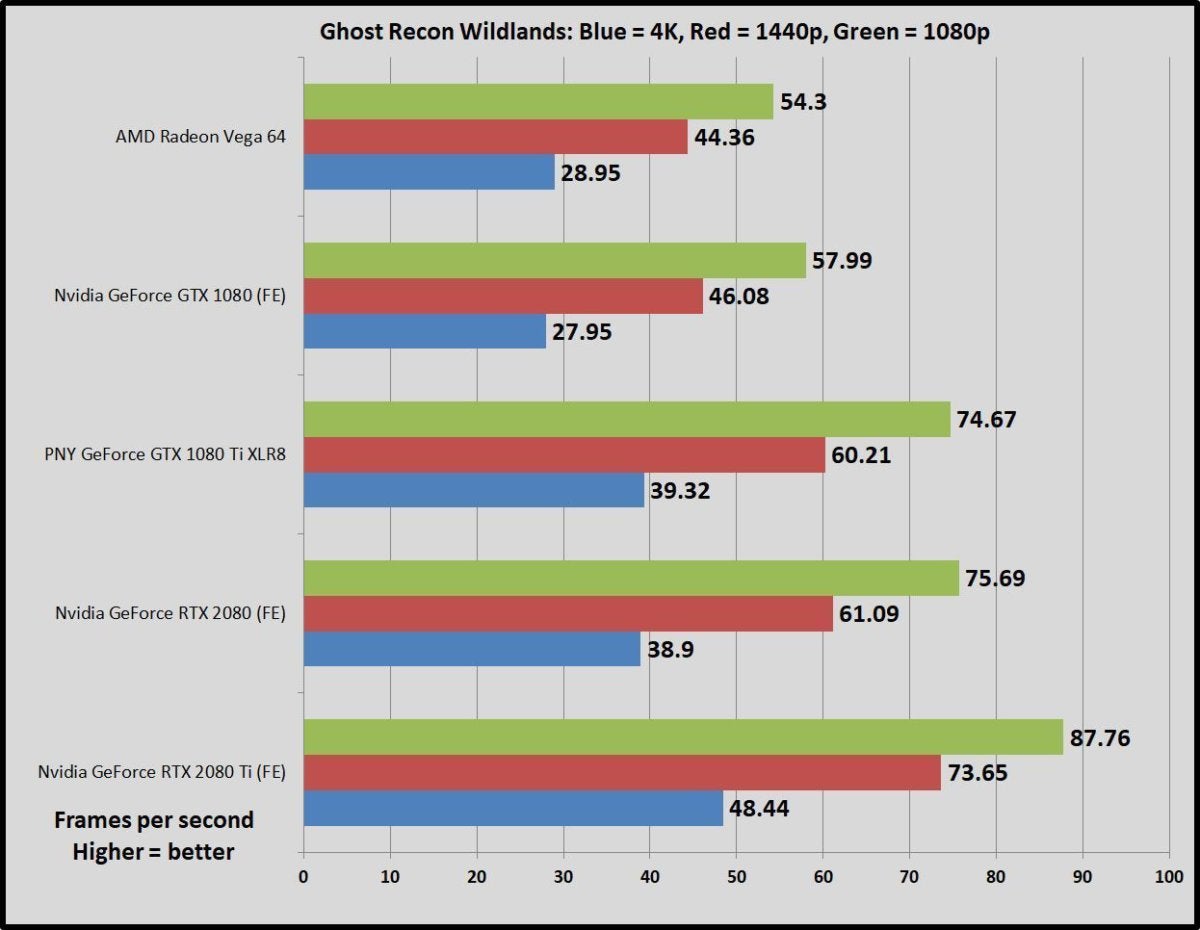
Ease up, Crysis. If you crank up all the artwork options up to 11, equivalent we manage for these tests, Specter Recon Wildlands ($50 on Humble) absolutely melts GPUs. True the GeForce RTX 2080 Ti can't get just about 60 fps at 4K resolution. Veneration not, though: Subsequent happening, we'll besides test these cards with the games tuned for Thomas More realistic scenarios.
 Brad Chacos/IDG
 The RTX 2080 and GTX 1080 Ti are neck-and-make out yet again, but the gap 'tween them and the RTX 2080 Ti closes significantly therein game. While the RTX 2080 Titanium pulled ahead by around 30 to 33 percent in the other games we've tested so far, in Ghost Recon Wildlands at 4K, that lead drops to around 23 to 25 percentage.
Next page: More benchmark results
Middle-earth: Shadow of State of war
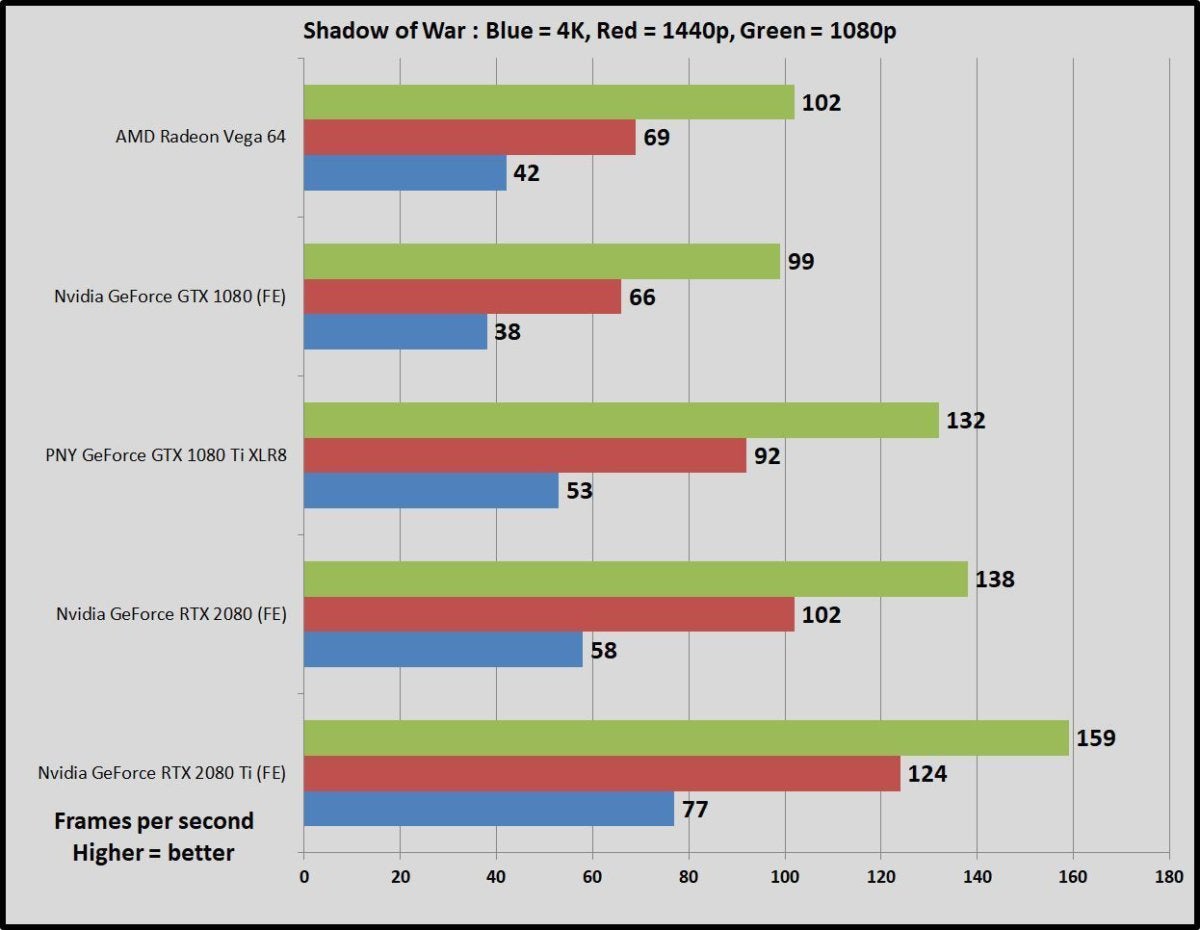
Midsection-earth: Shadow of War ($50 on Humble) adds a strategic bed to the series' sublime core gameplay loop, adapting the Scourge arrangement to let you create an ground forces of personalized Orc commanders. It plays ilk a champ on PC, too.
 Brad Chacos/IDG
 The RTX 2080 corset systematically ahead of the GTX 1080 Ti here, albeit by a lose weight margin, and the RTX 2080 Ti's performance trail opens back equal to around 33 percent at 4K resolution. It's a big 45 percent faster than the GTX 1080 Ti. Interestingly, AMD's Radeon Vega 64 noses forward of the GTX 1080.
F1 2018
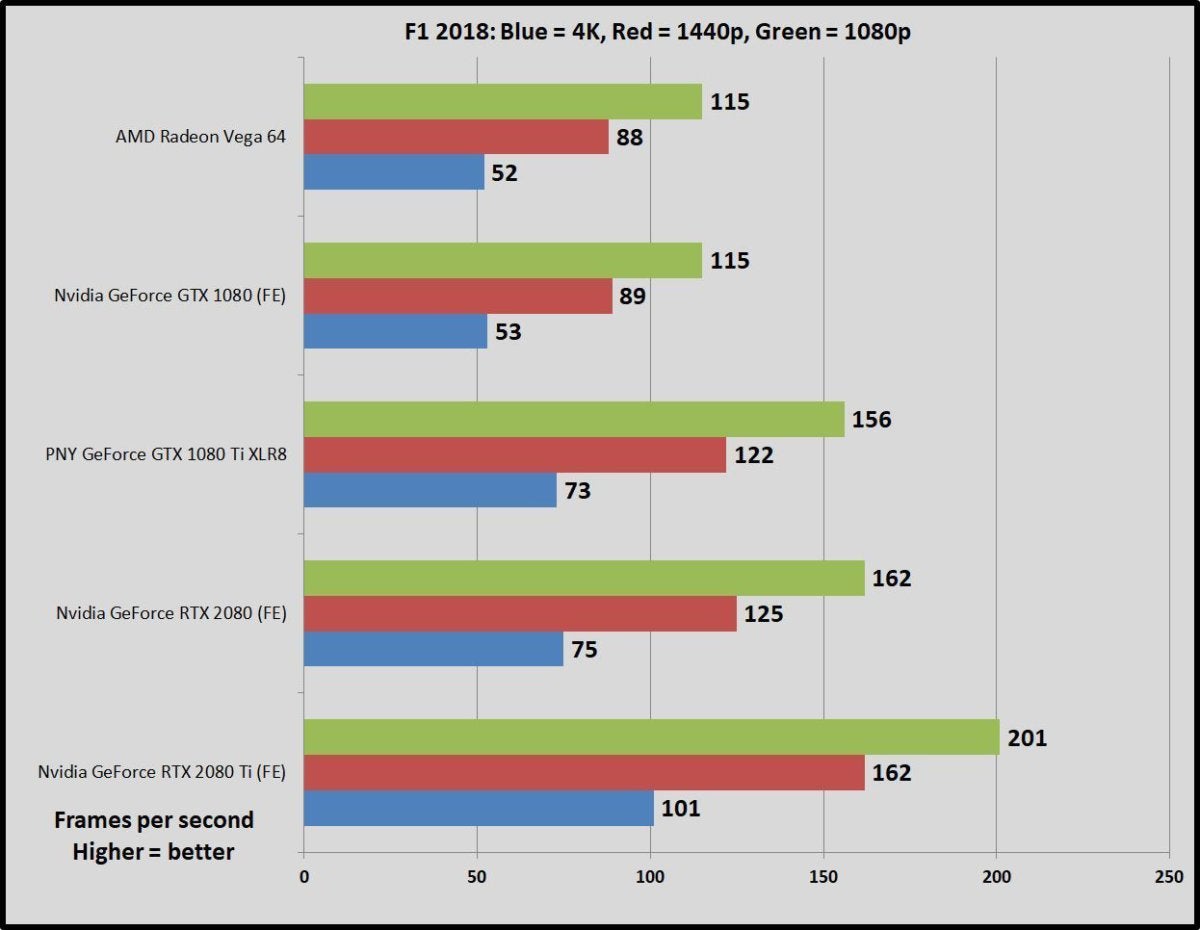
The latest in a long line of successful games, Codemasters' F1 2018 ($60 on Menial) is a benchmarking gemstone, supplying a wide array of both graphical and benchmarking options—making it a more more than reliable option than the Forza series. Confession time: Information technology's a good deal of fun, too. Tinkering with this for testing reasons quickly turned into an "extended benchmarking session." We test two laps on the Australia course, with clear skies.
 Brad Chacos/IDG
 Everything lands where you'd expect afterward beholding the performance in the other games.
Ashes of the Singularity: Escalation
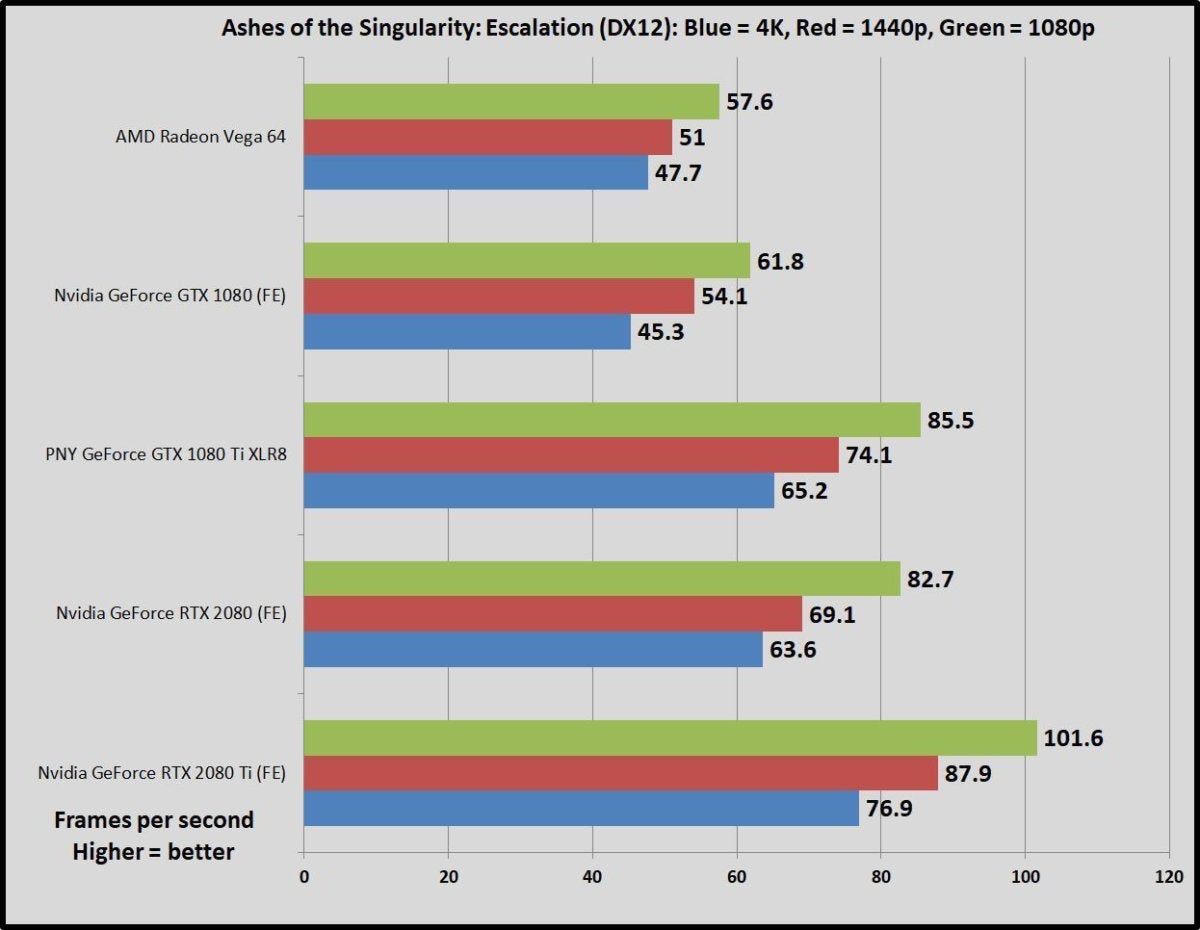
Ashes of the Uniqueness ($40 along Humble) was one of the very first DX12 games, and IT remains a flag-bearer for the engineering science to this day. With hundreds of units onscreen at the same time and some serious graphics effects in bring, the Crazy preset buns pretend graphics cards sweat. Ashes runs in some DX11 and DX12, but we trial run solitary in DX12, every bit it delivers the best results for both Nvidia and AMD GPUs.
 Brad Chacos/IDG
 This is other game where the RTX 2080 Si's lead dips, to some 18 percent compared to the runner-up, the 1080 Ti.
Incoming page: Thomas More benchmarks
Grand Theft Auto V
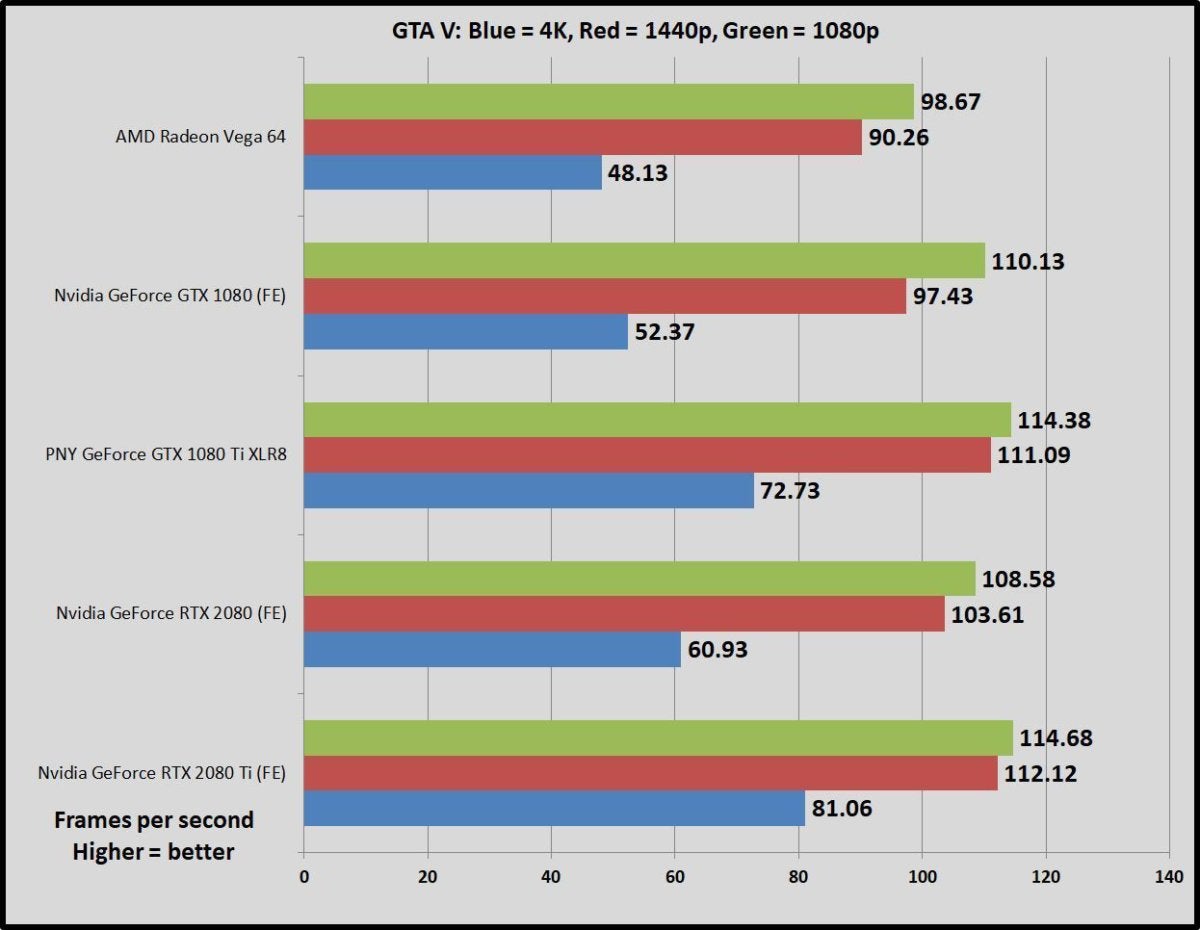
We're going to wrap things up with a couple of experienced games that aren't really visual b-burners, but nevertheless top the Steam charts day-in and Clarence Day-out. These are games that a lot of masses play. First up: Grand larceny Motorcar V ($30 on Humble) with all options turned to Very High, all Advanced Graphics options except big shadows enabled, and FXAA.
 Brad Chacos/IDG
 Now here's a surprise. The GTX 1080 Ti exhaustively stomps the RTX 2080 in public presentation, and patc the RTX 2080 Ti still comes out ahead, information technology's only by a miniscule 11.5 percent all over the GTX 1080 Si at 4K. (It's at the expected 33-percent vantage complete the RTX 2080.) What gives? We'ray not sure, and we re-ran the tests multiple times to ensure these results are right. I wanted to find fault the RTX 2080's far little ROP and texture unit numeration than the GTX 1080 Ti initially, but the RTX 2080 Titanium is loaded for bear and still turns in a comparatively holmium-seethe performance. GTA V simply doesn't suchlike the revamped Turing architecture as much as it does Pascal, for some reasonableness.
Rainbow Six Siege
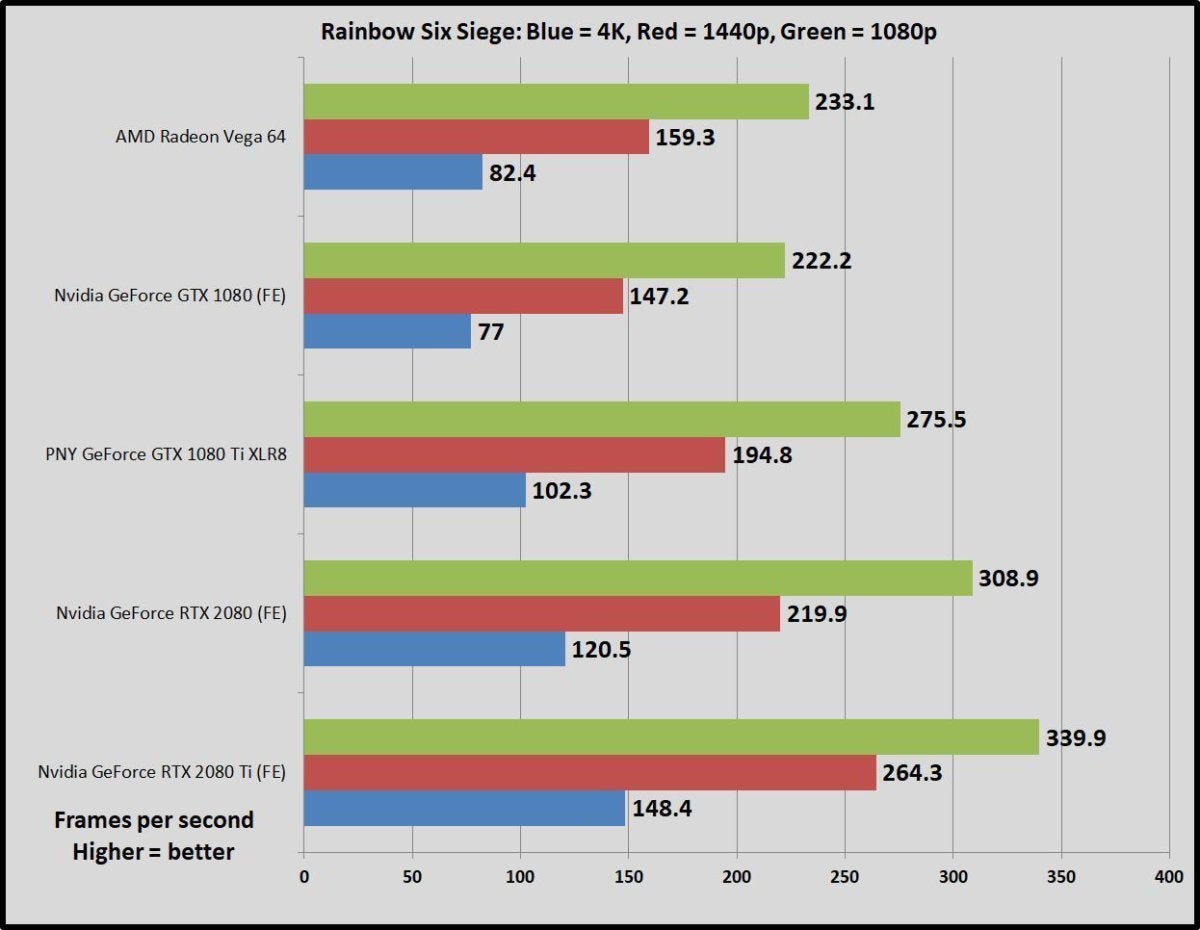
Finally, let's take a peek at Rainbow Six Siege ($40 on Humble), a game whose consultation just keeps on biological process, and one that still feels like the merely truly next-gen shooter afterwards all these years.
 Brad Chacos/IDG
 Things win back to normal here, though the RTX 2080 Ti opens up a larger-than-usual tip over the GTX 1080 Ti at 4K, delivering 45 percentage more performance. Vega 64 also holds an butt on concluded the GTX 1080, thus it's credibly callable to the Turing GPU's improved compute handling. The RTX 2080 Ti's lead o'er the RTX 2080 shrinks binding downwardly into the 23-percent array at 4K resolution, just that's not really a surprise considering how fast Rainbow Six Siege runs on every of these graphics cards.
Close page: Flack Strike, power draw, and thermals
Fire Strike, power draw, and thermals
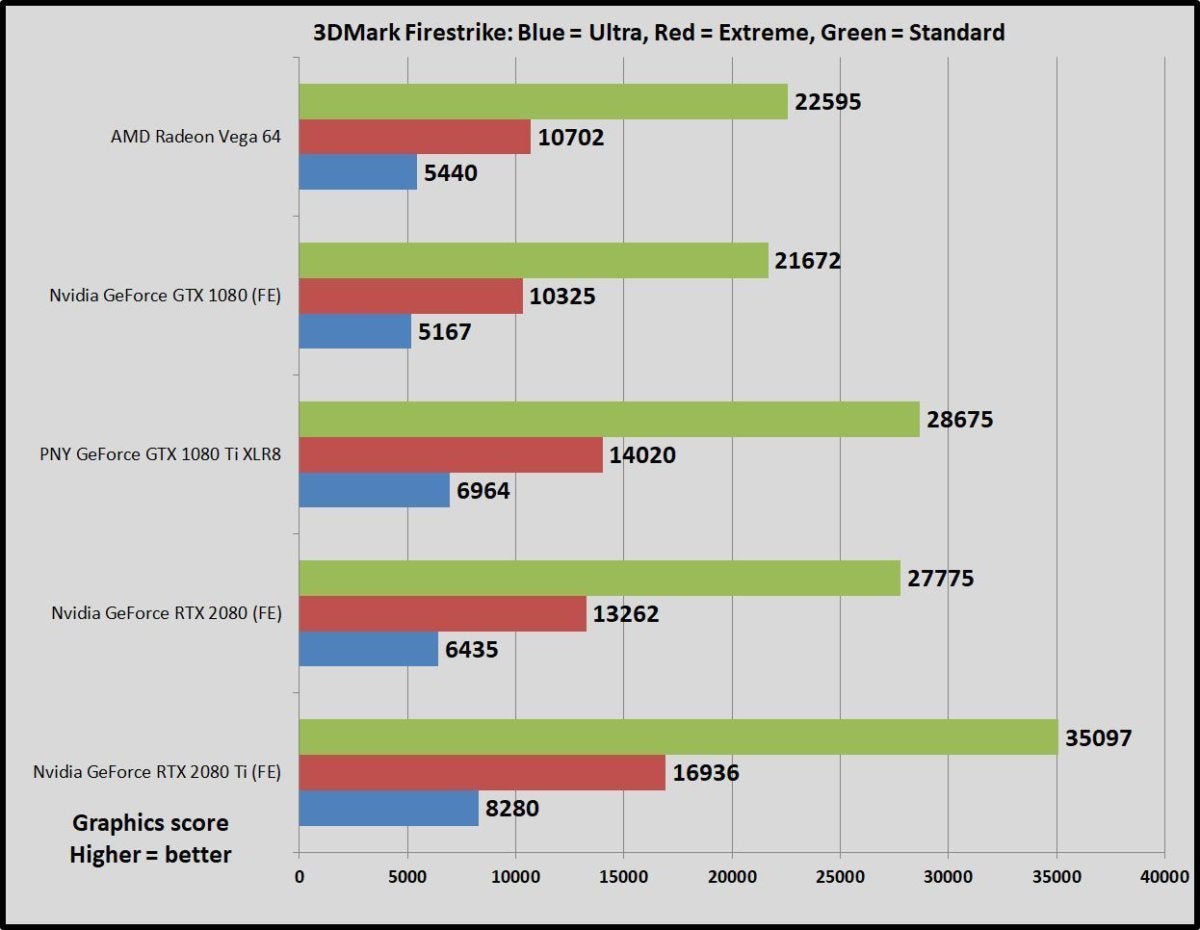
We besides tested the GeForce RTX 2080 and RTX 2080 Si Founders Edition cards victimization 3DMark's highly respected Go off Strike synthetic bench mark. Sack Strike runs at 1080p, Fire Mint Extreme runs at 1440p, and Fire Strike Ultra runs at 4K resolution. Completely render the same aspect, but with more wicked graphical effects as you act up the scale, so that Extreme and Ultra flavors stress GPUs straight-grained more. We record the graphics score to eliminate variance from the CPU.
 Brad Chacos/IDG
 Interestingly, the GTX 1080 Si outscores the RTX 2080 across the board, and the Vega 64 beats out the GTX 1080. The GeForce RTX 2080 Atomic number 2 is ahead of the RTX 2080 by some 28 percent at 4K/Ultra, smack-dab in the middle of the low-20s to low-down-30s leads it holds in real-world games.
Power draw
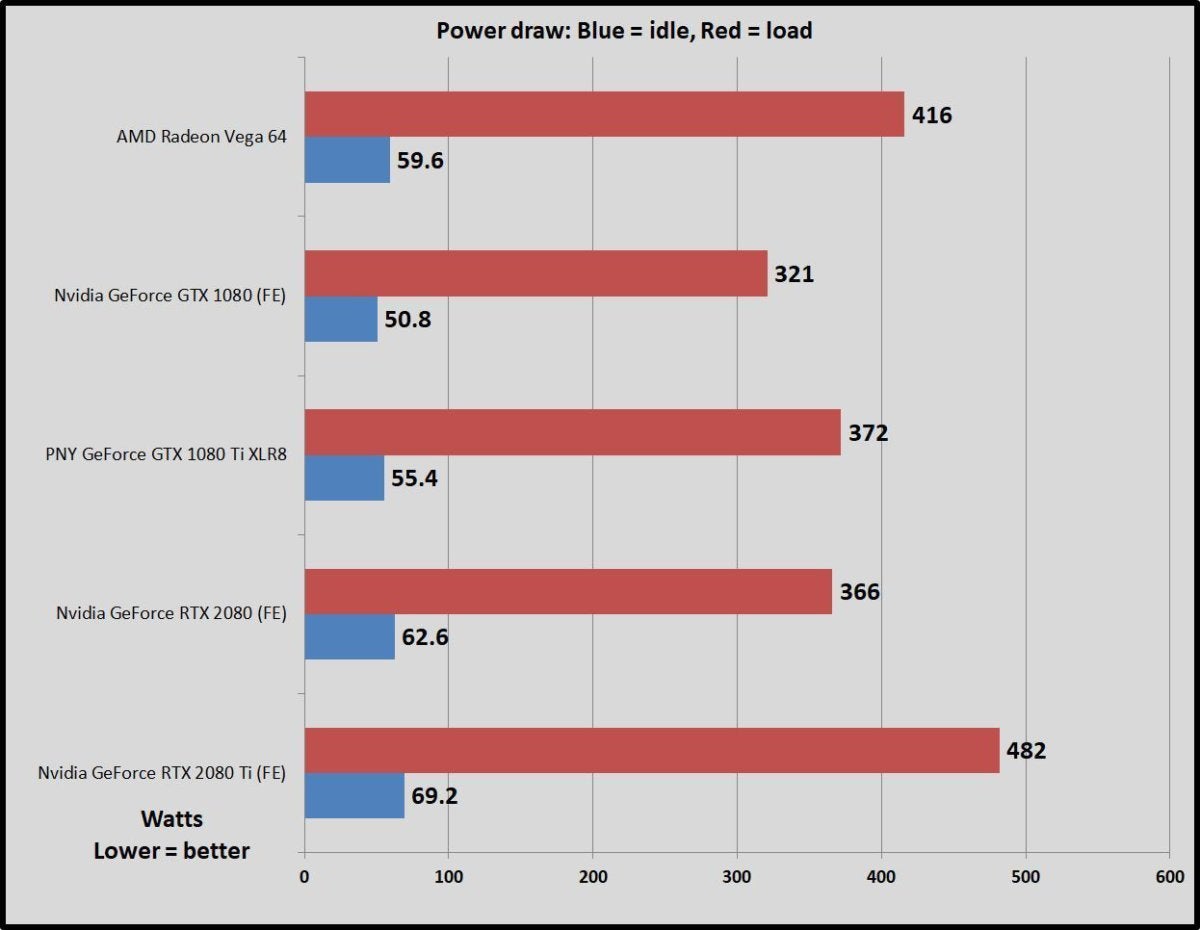
Nvidia's RTX graphics card game pack a lot more hardware than their predecessors, and IT shows when you compare the power draw for these cards. We examine power draw by iteration the F1 2018 bench mark after we've benchmarked everything else with a card, and noting the highest reading on our Watts Up In favor of meter. The initial split up of the raceway, where all competing cars are onscreen simultaneously, tends to be the most demanding portion.
 Brad Chacos/IDG
 Both RTX Founders Variant models have notably higher idle power draw than their rivals, though information technology's efficacious that the RTX 2080 manages to hang with the GTX 1080 Ti performance-wise patc suction down a little bit less juice. Remember how much we derided the Vega 64 for being hot, yelled, and power hangry? The GeForce RTX 2080 Cordyline terminalis draws significantly more energy from the wall—albeit while delivering 60 to 90 percent more gambling performance—with the whole system drawing a walloping 482W nether load.
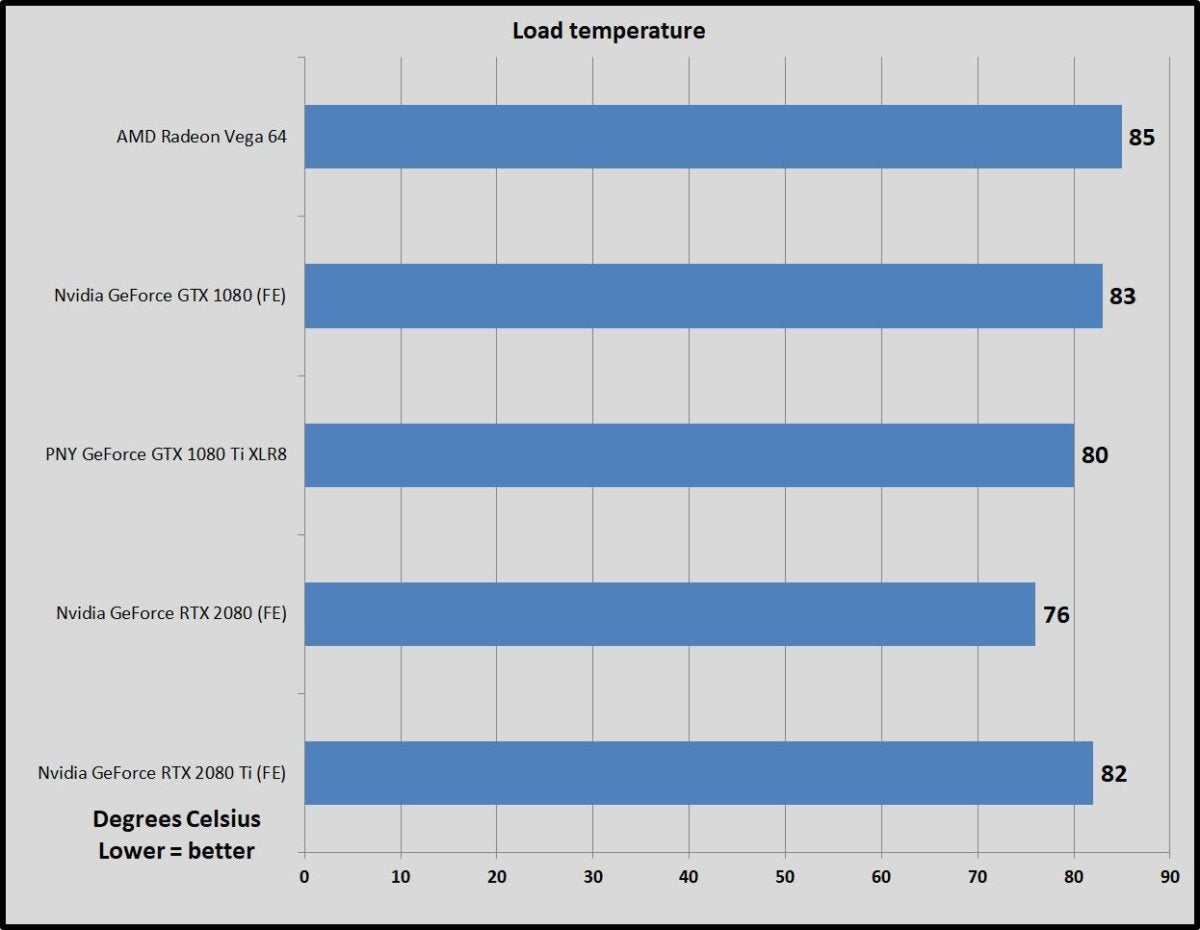
Information technology's nevertheless a lot more enjoyable art menu to have than AMD's hellacious Vega 64. We test thermals by leaving HWInfo's sensor monitoring tool open during the F1 2018 5-lap power draw test, noting the highest maximum temperature at the end.
 Brad Chacos/IDG
 Nvidia's talked about the improvements to the RTX Founders Version's chilling, and IT walks the walk present. Some the GeForce RTX 2080 and RTX 2080 Ti run noticeably quieter than the GTX 1080 Founders Edition, and the GeForce RTX 2080 Iron runs a meaning 7 degrees Celsius cooler than the GTX 1080 FE. Heck, the RTX 2080 is 4 degrees Anders Celsius cooler than the triple-fan custom PNY GTX 1080 Ti. It's an stately improvement, though you have to admiration how Nvidia's partners will feel about how the fellowship's essentially stepping connected their toes. While we haven't tested any of the early custom RTX graphics cards nonetheless, they've resorted to massive, metal-filled coolers to stand retired, and that drives up costs well.
Character Vega cards still suck. Womp womp.
Next page: Sharp/no more AA 4K gaming operation
High/no AA 4K gaming performance
When you're buying a graphics card that costs $800 OR $1,200, you want to crank every last the options to the max. That's a eager way to push graphics cards to their limit to test performance. But Here's the affair: That's not really how all but people gambol games at 4K resolution, including yours sincerely.
Falling from Extremist down to High graphics normally provides a significant performance boost with little visual retrogression, while many mass swear off opposing-aliasing (AA) at 4K, because each those pixels look mighty powdered without extra smoothing. Making those tweaks lets you achieve far higher real-world form rates in games, a censorious consideration straight off that 4K, 144Hz G-Sync HDR monitors like the Acer Predator X27 throw arrived.
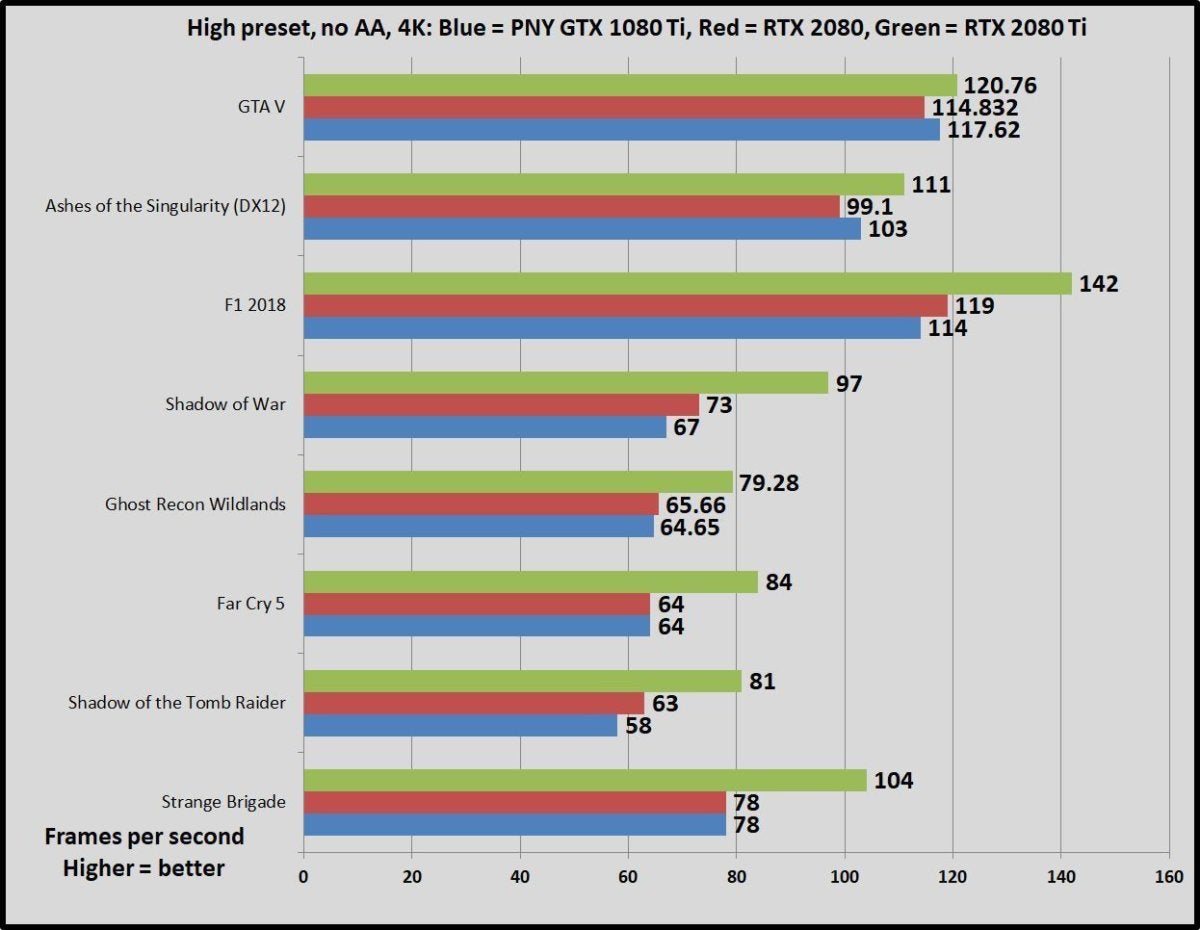
With that in creative thinker, we distinct to bench mark our games with their Squealing graphics preset and AA disabled at 4K resolution, to see how much performance you can expect in more realistic high refresh-rate scenarios. We only did indeed with the GeForce RTX 2080, RTX 2080 Ti, and PNY GeForce GTX 1080 Ti, Eastern Samoa they're the true 4K graphics cards. Coddler: They'Ra all fast.
 Brad Chacos/IDG
 At these much reasonable settings, the GTX 1080 Ti and RTX 2080 still trade blows, but both hit average frame rates in excess of 60 fps across all well-tried titles. The GeForce RTX 2080 Atomic number 2 far surpasses that, clearing 80 fps at 4K/High in its worst-case scenario. If you don't thinker tweaking a few settings, altogether of these card game testament deliver solid 4K gaming carrying out. The GeForce RTX 2080 Atomic number 2 can definitely keep the new breed of faster 4K displays overbusy, although non maxed-out.
Next page: 4K HDR performance
GeForce RTX 2080 and RTX 2080 Ti HDR performance
Hey! HDR PC monitors are a thing now. Nvidia's early GeForce RTX 2080 and RTX 2080 Ti marketing materials pushed 4K HDR carrying into action, and the reviewers guide provided for the cards let in a sizeable section along how to benchmark HDR performance. Nvidia's premature GTX 10-serial graphics cards lost a astonishingly decent chunk of performance when displaying HDR—much more and then than comparable Radeon Vega GPUs. So we decided to test 4K HDR performance for the GeForce RTX 20-series and older GTX 10-series cards.
"The Turing GPU architecture improves Pinched Dynamic Ambit (HDR) gaming performance and input response time exploitation ironware-founded compositing, tone correspondence, and chroma filtering with HDR surfaces," Nvidia says.
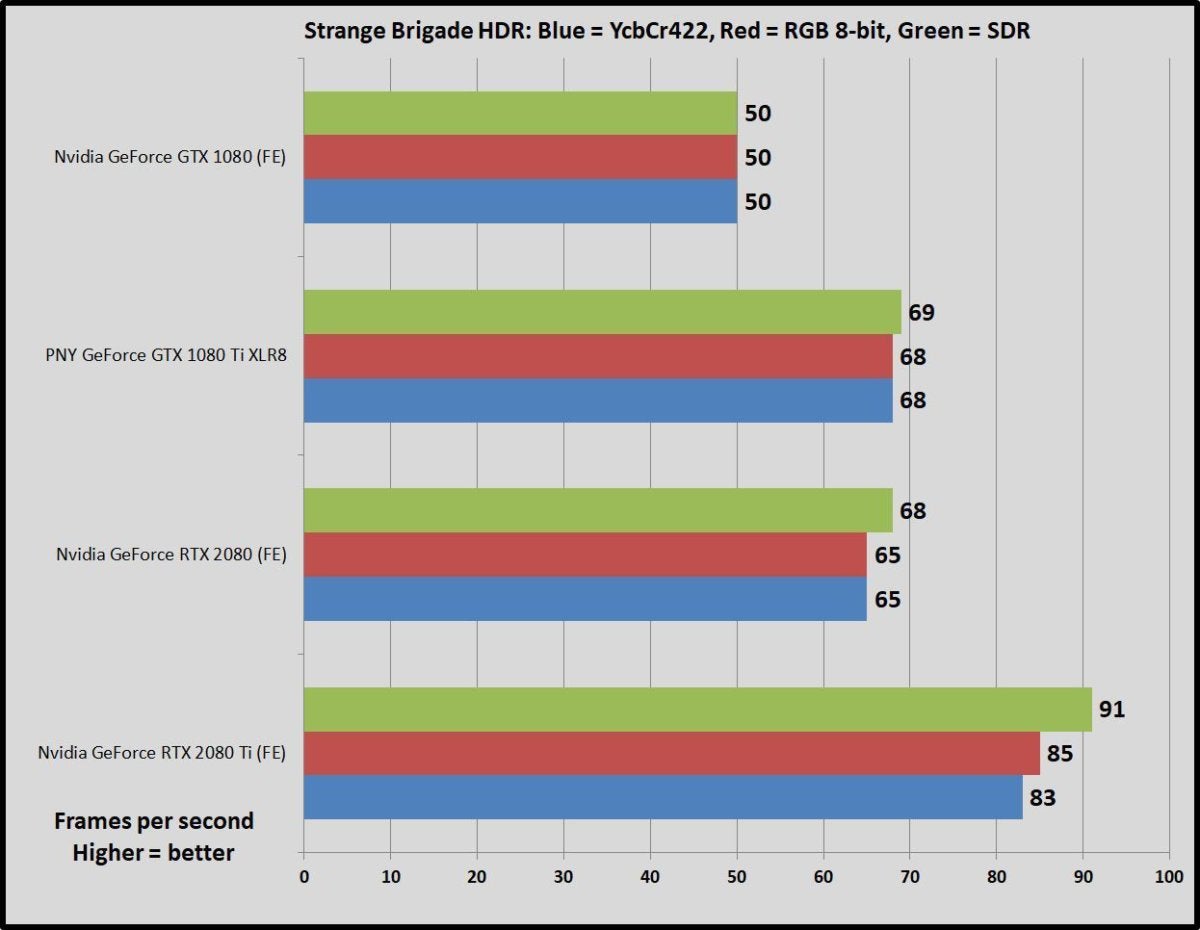
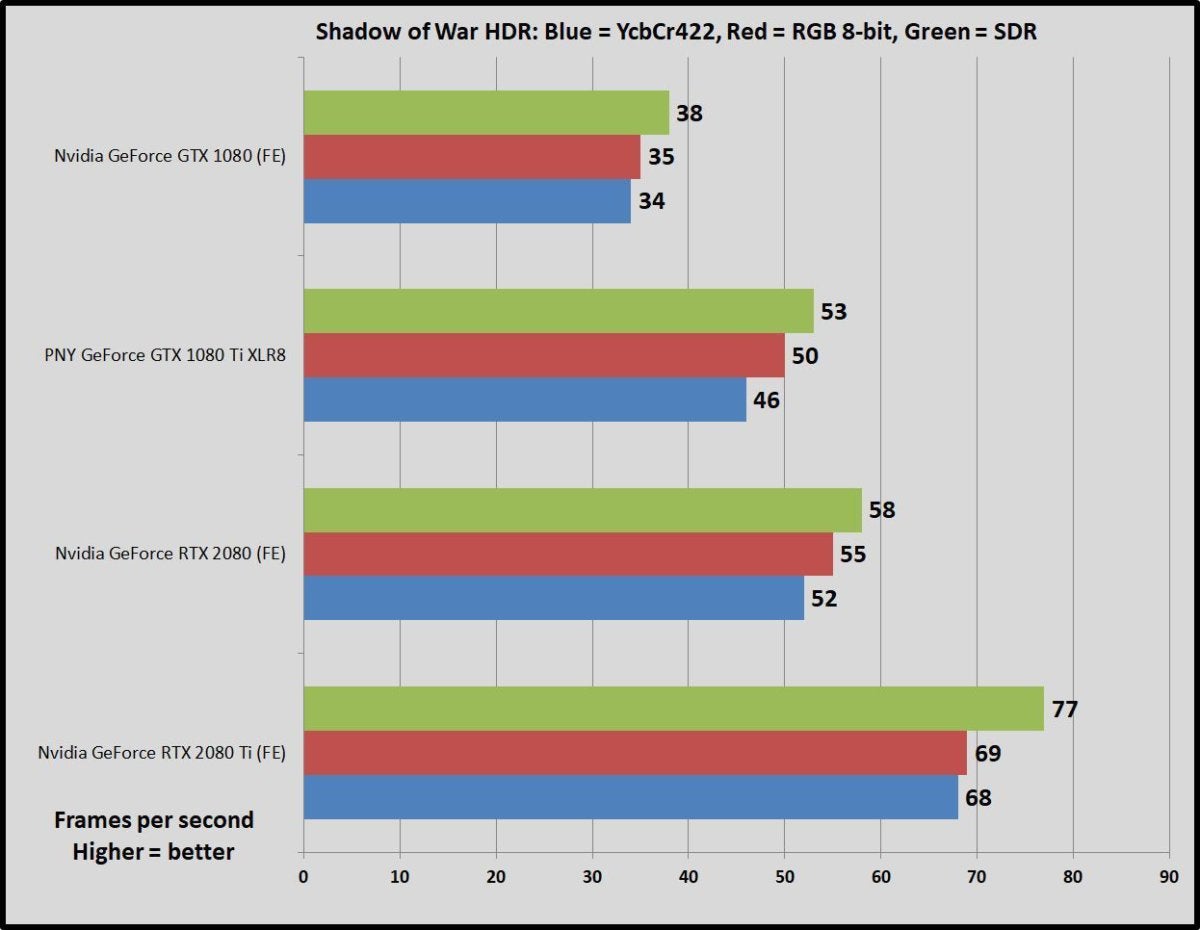
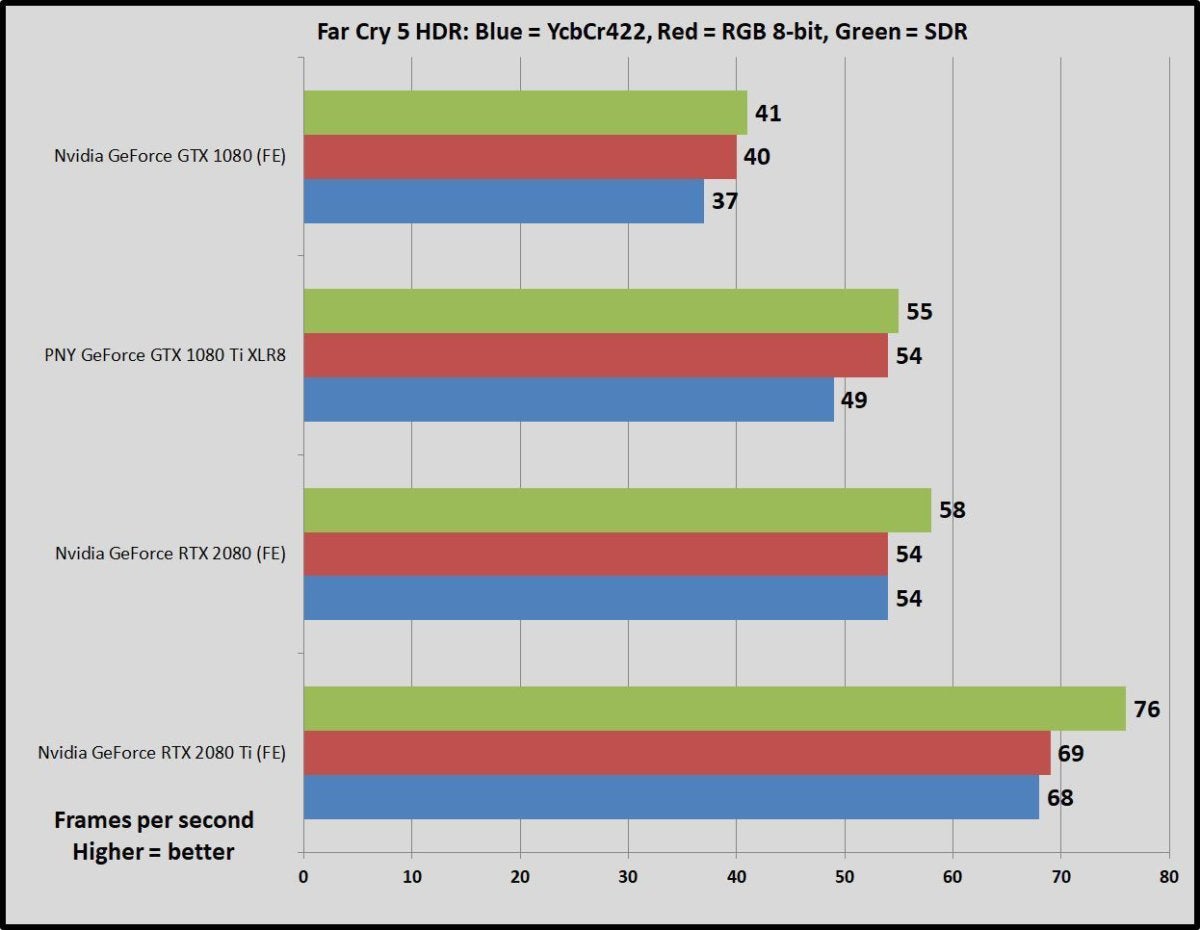
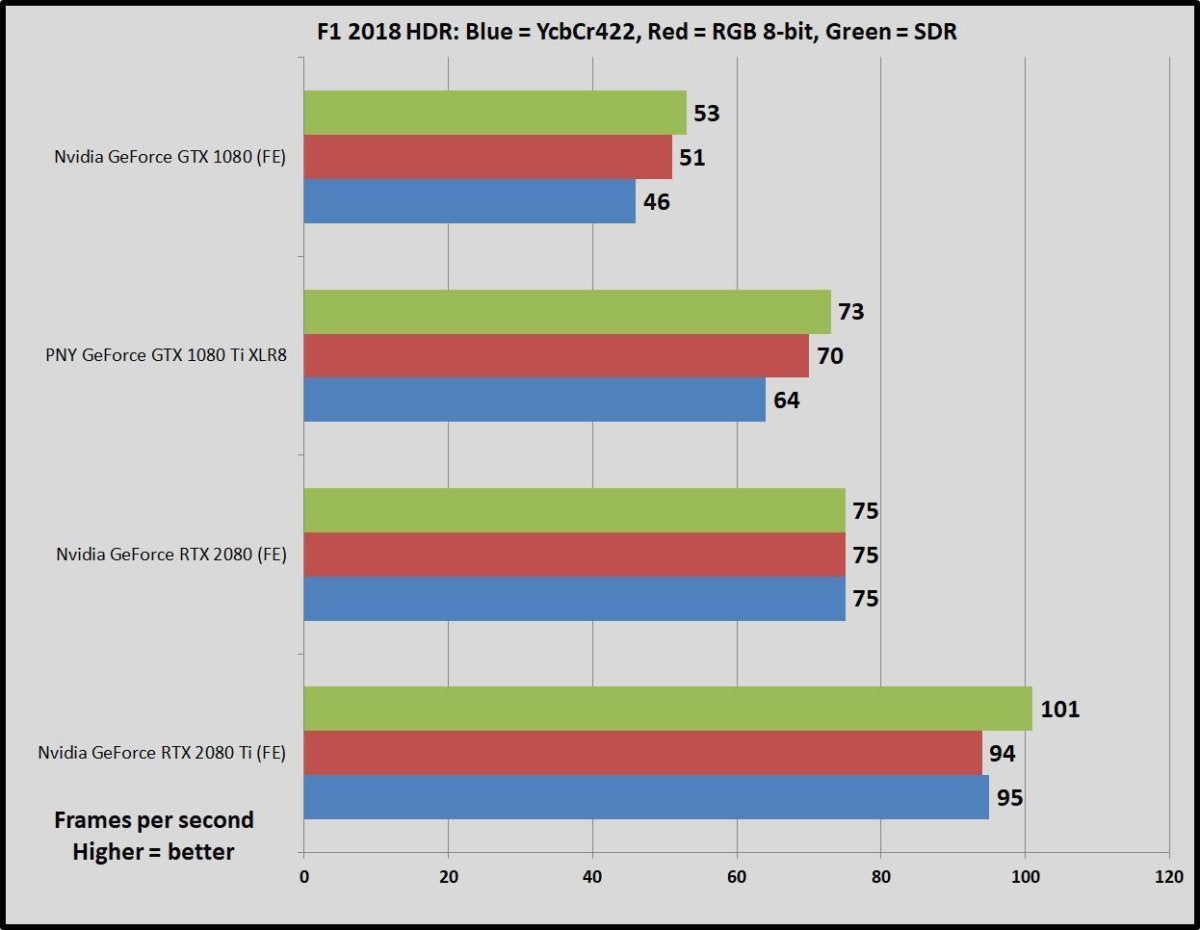
We retested the HDR-compatible games in our suite using both the 8-act RGB and 10-bit YCbCr422 settings available along the Predator X27 at 120Hz, and the same artwork presets as our standard benchmarks. Hither are the results for each, along with the performance for each game when you're non using HDR (listed below atomic number 3 "SDR.")
 Brad Chacos/IDG
  Brad Chacos/IDG
  Brad Chacos/IDG
  Brad Chacos/IDG
 Zero in on the RTX 2080 and GTX 1080 Ti here, as the graphics card game trade blows in overall gaming performance. The RTX 2080 lul loses any performance when you throw to HDR, but total information technology loses to a lesser degree the older GTX 1080 Si, specially when victimisation the YCbCr422 color space (which wrecks the look on of onscreen text edition outside of games). In that pessimal-case YCbCr422 scenario, the RTX 2080 loses as average of 5.89 percent functioning across completely four HDR-enabled games; the GTX 1080 Ti loses an medium of 10.38 percent. That's a significant improvement, and those numbers will be even glower if you use the superior 8-bit RGB tinge blank option instead.
The GeForce RTX 2080 Ti loses a big chunk of performance when it enables HDR, in all likelihood because it's wriggly so umteen more pixels. It loses an average of 10.24 percent at 4K with YCbCr422 HDR enabled, though again, that loss narrows if you move to 8-bit RGB. Even with the HDR hit, the GeForce RTX 2080 Ti still blows away the competition.
Next varlet: Ray tracing and DLSS performance
Turing tomorrow: Ray tracing and DLSS execution
Now for the artful character. The very reason the GeForce RTX 2080 and RTX 2080 Atomic number 2 exist is for a early wave of games—ones powered by ray tracing and augmented by political machine encyclopaedism. A large amount of the Turing GPU's die down is ordained to the tensor and RT cores compulsory for those newfangled technologies. But even though Nvidia has more than than 25 games lined up to support beam of light trace or Deep Learning Super Sample, some to no of those will be available when the RTX 20-series cards launch.
The first gear ray copied games won't be for sale until about a month later, when the Windows 10 October 2018 updates rolls out with support enabled for Microsoft's DirectX Raytracing API (which underpins Nvidia's RTX ray tracing endeavors). Deep Learning Super Sample leverages the Turing GPU's tensor cores and doesn't need the DirectX Raytracing API, but there's even no word on when games will roll out with DLSS support. Nvidia didn't respond when we asked. Fortunately, it sent over more or less technological demos to Lashkar-e-Taiba us see the new technologies in action firsthand, though we couldn't take television of the experiences.
First upwards: The hilarious Star Wars reflections period ray tracing demo by Illusional, which debuted at the RTX 20-series reveal. Yes, we ran this demo straight on our own machine. Here's the trailer:
IT proved scarce as impressive actually at 1440p and 4K resolution, though not quite a as seamless. The demo was created to draw at a medium 24 frames. You could unlock the framing pace, but it hovered around there on some the GeForce RTX 2080 and RTX 2080 Ti. What did modification was the visual quality.
Spell the TV above looks smooth and perceptive, jetting it on my local rig with the RTX cards exhibited some "graininess," the visual noise related with real-sentence ray copied graphics. This Quake 2 video shows an extreme version of the effectuate. It's nowhere near as intense in the Star Wars demo—not even stopping point—but IT is there. The coarseness almost looks like a flic grain effect, only it's more pronounced on the GeForce RTX 2080, which has 56.5 per centum fewer RT and tensor cores than the RTX 2080 Ti. (Turing uses RT cores to forecast ray tracing paths, then uses the simple machine eruditeness-convergent tensor cores to de-noise the sequent visuals.)
The noisiness is most noticeable in the Andrew Dickson White Stormtrooper armor. It makes the edges of that armor appear jagged—like information technology hasn't had proper anti-aliasing applied—when information technology's on the edge of that armour, against a dark background. The jagged abut effect mostly went away on the GeForce RTX 2080 Ti, and the demo looks beautiful overall despite these criticisms.
You know what doesn't look good, though? Running the Whizz Wars demonstrate on the GTX 1080 Titanium, which lacks the dedicated radiate tracing computer hardware of the RTX 20-series. It does still operate—the DirectX Raytracing API has a fallback path for all DirectX 12-capable GPUs—but horribly. Horribly. It hit between 7 to 13 frames per endorsement, depending on the scene, with distant graininess and jagged edges. Watching it legit ready-made me nauseated. If you want to run irradiatio traced games right now, you need a GeForce RTX 2080 Oregon 2080 Cordyline terminalis.
 Nvidia
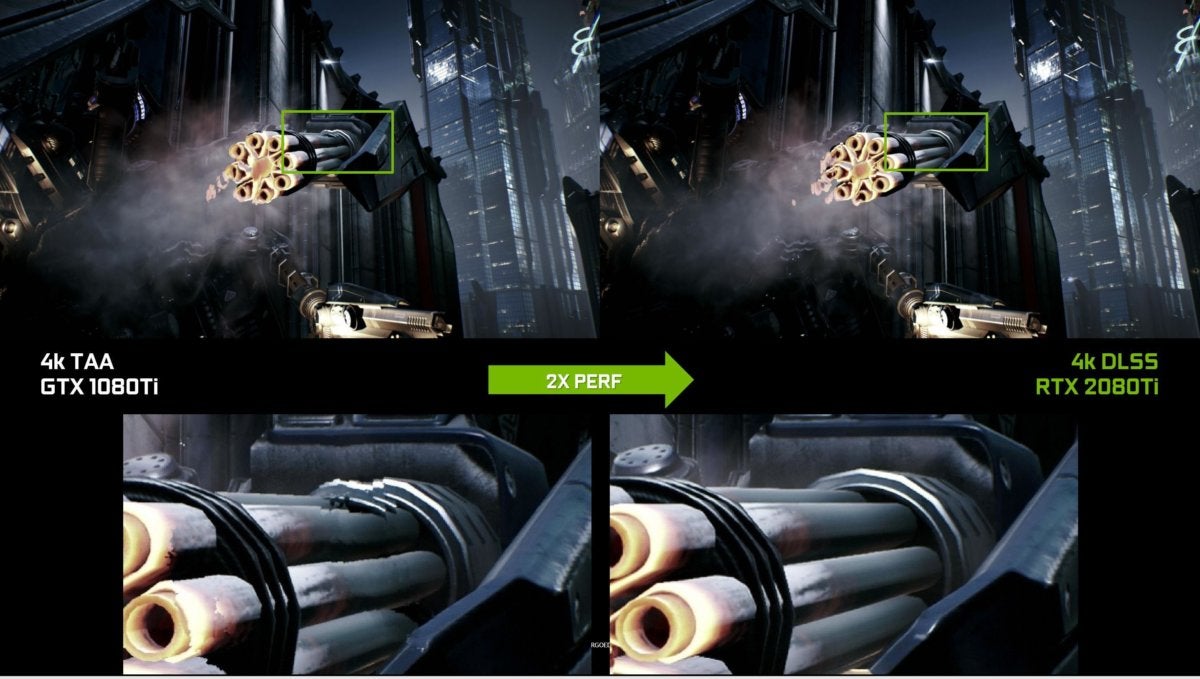
 The Infiltrator exhibit.
Nvidia too dispatched over a couplet of demos showing off the potency of its Deep Learning Super Sampling technology. We mud-beplastered the applied science in our Alan Mathison Turin GPU deep-dive, but to proceed it short, DLSS uses tensor cores infused with knowledge from Nvidia's Saturn V supercomputer to apply an antialiasing effect similar to (or healthier than, with DLSS 2x) earthly anti-aliasing, but at a significantly lower performance hit.
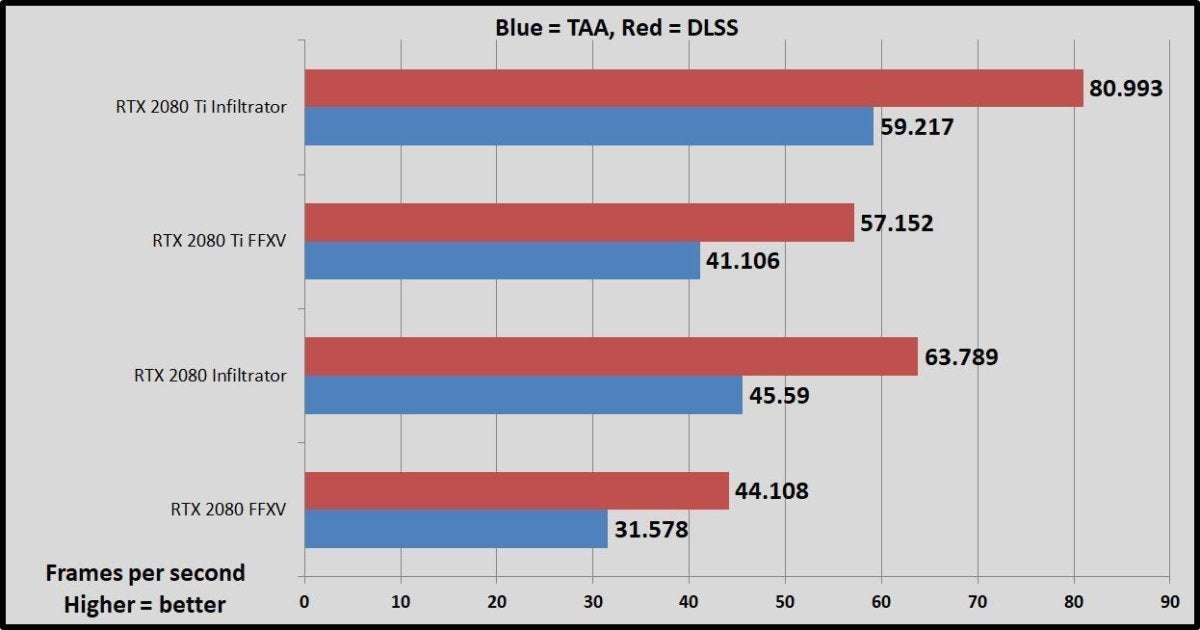
How much lower? Nvidia sent along DLSS-equipped 4K versions of Unreal's Infiltrator exhibit and the Final Fantasy XV benchmark (which will be made available to the public happening September 20). You throne running game them with either TAA or DLSS active, although DLSS works only with RTX graphics cards imbued with tensor cores. Cue the FRAPS benchmarking tool!
 Brad Chacos/IDG
 Whoa. That's a massive 39 percent performance uptick across the board with nary loss in visual timber, and a lot better have boilersuit. The Infiltrator demo chugs and stutters with TAA enabled when the hero's vulnerable by a chaingun toward the end, e.g., and again when atomic number 2 loads the rocket launcher attachment onto his gun. With DLSS enabled, those scenes get along perfectly smooth. That universal 39 pct carrying into action uptick is flat more effectual when you consider that the RTX 2080 crams in only about half equally umpteen tensor cores American Samoa the RTX 2080 Ti.
It's badly impressive stuff, and I'm very excited to picture if this sort of performance improvement proves property outside of canned demos. DLSS is coming to a slip of games, including heavy hitters look-alike Ark: Survival Evolved, PlayerUnknown's Battlegrounds, Hitman 2, Shadow of the Grave Despoiler, and Hellblade: Senua's Sacrifice. The only question is when.
Next page: Should you buy GeForce RTX?
Should you buy the GeForce RTX 2080 and RTX 2080 Ti?
And that's the question that plagues the GeForce RTX 2080 and RTX 2080 Ti's found. When?
Nvidia's beastly Turing-powered art card game were built for the bleeding-edge future of gaming. Approximately of those fruits bear results nowadays; these cards exhibit HDR visuals much many expeditiously, and the GeForce RTX 2080 Ti is the first graphics card capable of smashing the late 4K/60 public presentation barrier, especially if you're prepared to dial back some graphics options. VirtualLink is based on by indeed many companies the number one congenial headsets don't seem very ALIR dispatch, either. Those are real gains for gaming enthusiasts that could be boosted even further if DLSS takes disconnected.
 Brad Chacos/IDG
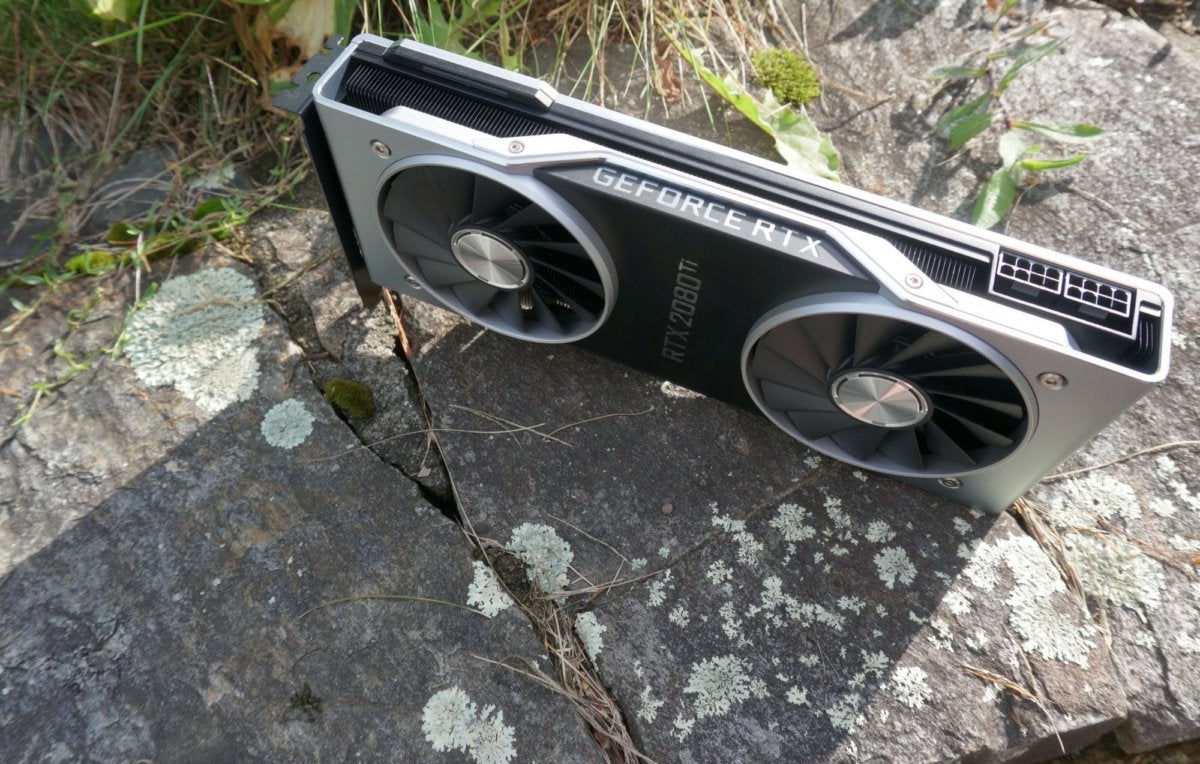
 The GeForce RTX 2080 Ti Founders Edition, with real-metre rays.
Could be. If. When. Much of the GeForce RTX 2080 and GeForce RTX 2080 Ti's true potential lies in technologies that simply aren't available today, even for reviewers. Deep Learning Super Sampling holds awesome possible if it's embraced by developers. All developer I've talked to positively gushes about the idea of time period ray tracing finally being achievable, though its performance impact remains to embody seen. These could be tectonic shifts in PC gaming. Could be. Nowadays, buying a GeForce RTX 2080 or RTX 2080 Ti requires a leap of faith.
That leap of faith's flat Sir Thomas More discouraging when you consider the staggering price of these graphics cards. The GeForce RTX 2080 Founders Edition costs $800 at Best BuyRemove non-product link and GeForce.com, and the GeForce RTX 2080 Te costs $1,200 at the best BuyRemove not-product colligate and GeForce.com. The previous-gen GTX 1080 started at $600, and the GTX 1080 Ti launched at $700. Remember, however, that Nvidia says models of the RTX 2080 volition outset at $700, and you'll eventually find GeForce RTX 2080 Ti models at $1,000.
Merely again: When? Just like last generation, the first wave of custom RTX art cards treats the Founders Edition price as the baseline rather than a insurance premium. Don't expect to see those lower prices for a spell. The travel to the RTX 20-series effectively increased graphics card pricing by hundreds of dollars, and the futuristic new hardware that caused the hike canful't exist used right now.
Soh we're holding off along a closing rating until ray tracing, DLSS, and Nvidia's other new technologies starting signal hitting the streets. These cards are assembled for tomorrow. We can't furnish a final verdict now.
What we can do is offer advice founded along the information available.
 Brad Chacos/IDG
 The GeForce RTX 2080 Titanium is the tardily one. The huge saltation from $700 to $1,000—though you'd need to make up $1,200 to buy one today—is hard to immerse, but some enthusiasts spare no expense on driving American Samoa many frames as possible. If you've got deep pockets and the burning trust to feed a 4K, 144Hz monitors like the G-Sync HDR-equipped, $2,000 Vulture 27 or the wave of (relatively) more affordable high-speed Acer displays, the GeForce RTX 2080 Ti is the sole very option. It's the fastest graphics card ever released, and friends, IT makes for an perfectly elated pairing with the Predator X27.
The GeForce RTX 2080 Ti's gains over the GTX 1080 Ti at 4K resolution ranges from 11.5 pct inGTA V to a whopping 45.28 percent inShadow of War. Averaged across our entire testing suite, it's about 33 percent quicker than its predecessor. The GeForce RTX 2080 Si obliterates the speed vs. fidelity compromise of the 4K/60 era, and information technology could wind up achieving level loftier heights if DLSS takes off. Right now, today, it's enabling experiences that bu weren't possible before, though you pay for the privilege. And Nvidia's revamped Founders Edition design is surprisingly sturdy, attractive, and effective.
The GeForce RTX 2080 is trickier.
The Founders Edition card carries a slight overclock, and trades blows with an overclocked PNY GTX 1080 Ti in traditional games. You can buy a customized, overclocked GTX 1080 Cordyline terminalis for $700 on Newegg right now, or even less if you find a deal, which isn't too hard to do. The GeForce RTX 2080 Founders Variation costs $800, and custom card game sell for more—sometimes significantly sol. We've yet to trial run the effectiveness of the ane-clink Nvidia Image scanner overclocking tool, and we'Ra laying hands on custom RTX 2080 cards soon to figure how far they're competent to push. But compared to an overclocked GTX 1080 Ti out of the box, you're paying a significant price superior for the GeForce RTX 2080 today, with no increment in traditional performance.
Sound Learning Super Sample distribution is like necromancy in the demos we proven. If DLSS blows up and stays faithful the 39-percent performance gains shown in our Nvidia-provided demos, that could push the GeForce RTX 2080 well past the GTX 1080 Ti in supported titles. Could. Our active with the Star Wars demo proves that the GTX 1080 Ti sucks at ray trace, so if you believe that developers leave embrace the technology nut masse in the near future, you might drop the RTX 2080's premium to ensure a seat connected the train. Retrieve, though, that the shortened-down RTX 2080 itself doesn't render the Star Wars demo as cleanly As the pricier RTX 2080 Ti. And we quiet don't recognize what classify of performance impact period ray tracing will have in games—or how the final results will look.
 Brad Chacos/IDG
 Like I same: Investing in the GeForce RTX 20-series today is a leap of trust, particularly for the RTX 2080. I backside't deny the savory potential of DLSS and ray tracing, but who knows what the future will bring? Lots of hoi polloi expected DirectX 12 to explode two GPU generations ago, after all. If you believe in Nvidia's vision and want to help crack this technology's chicken-or-the-egg scenario, past whol means, stock. You know what you'atomic number 75 getting into equally far as traditional gaming performance, at least. But if, look-alike us, you want more proof in front reaching a verdict along these futuristic graphics cards, the wait for benchmarks continues.
We'll update this reappraisal when those ray tracing and DLSS benchmark results go possible.
Note: When you purchase something after clicking golf links in our articles, we English hawthorn gain a small commission. Read our affiliate link policy for more inside information.
Source: https://www.pcworld.com/article/402619/nvidia-geforce-rtx-2080-and-rtx-2080-ti-review.html
Posted by: beasleyjustoll.blogspot.com
0 Response to "Nvidia GeForce RTX 2080 and RTX 2080 Ti review: Changing the game - beasleyjustoll"
Post a Comment